Grain-Free Food and Bernese Mountain Dogs: What the FDA DCM Investigation Found
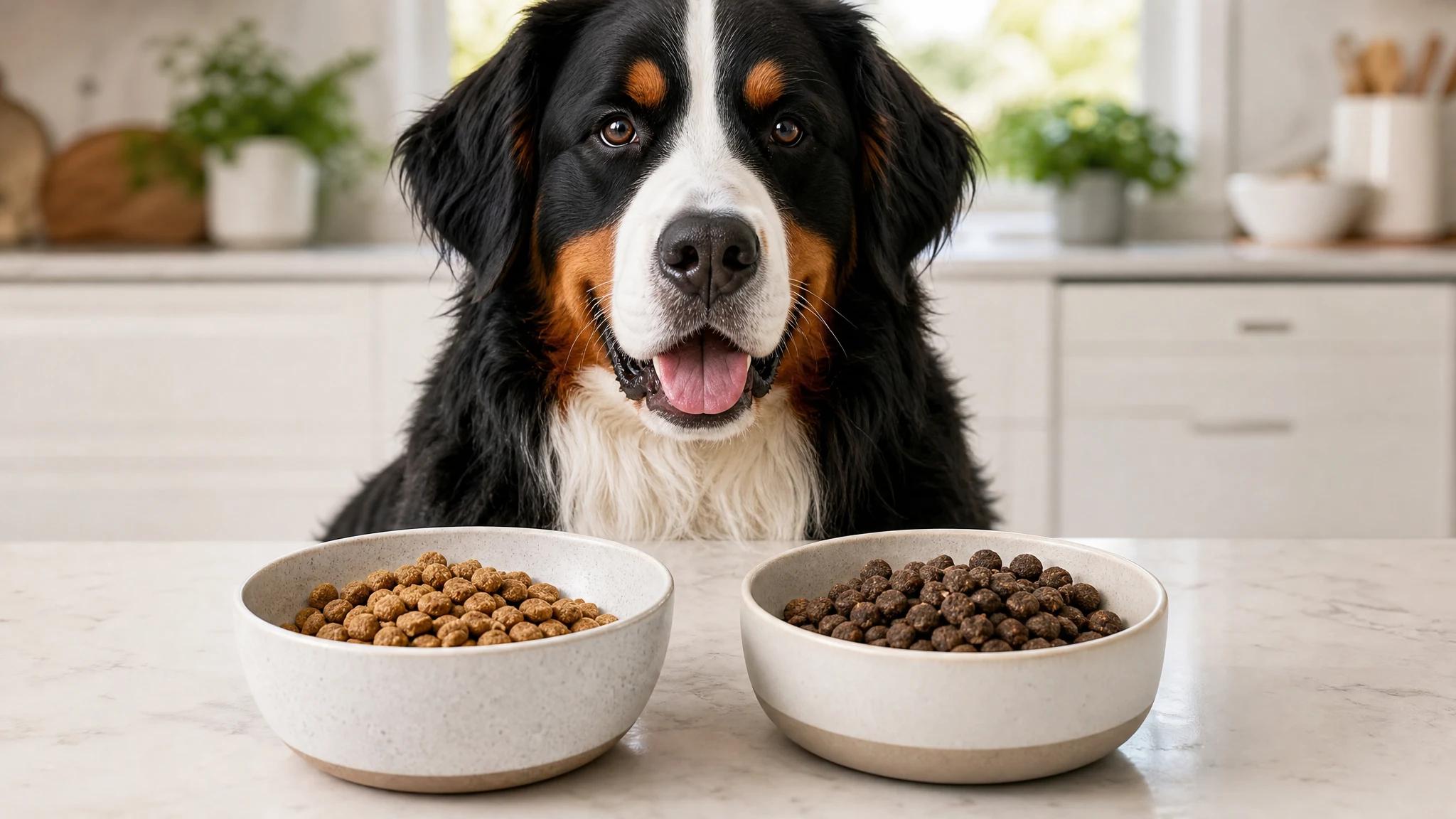
General nutrition information compiled from product labels and published sources, not veterinary advice. Your veterinarian is the right person to choose a diet for your dog, especially one with a health condition.
If you share your home with a Bernese Mountain Dog, you have probably seen grain free dog food promoted as a healthier choice. You may also have seen warnings that link grain free dog food and DCM, short for dilated cardiomyopathy, a heart condition. Both messages can leave an owner unsure what to do.
This guide walks through the question one step at a time. You will read what the FDA's Center for Veterinary Medicine (CVM) published, what the agency has and has not said, and how to bring a clear set of questions to your veterinarian. It does not tell you which food to buy, and it does not claim any food prevents or causes a disease.
The short version
The FDA CVM has an investigation page titled "FDA Investigation into Potential Link between Certain Diets and Canine Dilated Cardiomyopathy." The word "potential" matters. The page describes a possible link that has been investigated, not a settled cause.
The latest update on that page is dated December 23, 2022. The FDA says it does not intend to release further public updates until there is meaningful new scientific information. So the most recent public update is several years old, and you should open the FDA page yourself to see its current wording.
What you need
Gather these before you start. None of them cost anything.
- The bag or can your dog eats now, or a photo of its label.
- The ingredient list and the nutritional adequacy (AAFCO) statement from that label.
- Your dog's age, current weight and body condition, as your veterinarian last recorded them.
- A list of everything else your dog eats: treats, toppers, chews and table scraps.
- The FDA CVM investigation page, linked in the Sources list below.
- A notebook or phone note for questions to ask at your next visit.
Step 1: Understand what DCM is and what "grain free" means
Dilated cardiomyopathy is a disease of the heart muscle. The FDA investigation is about whether certain diets may be linked to it in dogs. That is the full scope of what this page covers.
"Grain free" is a marketing description, not a nutrition category with a single legal definition. A grain free recipe simply leaves out grains such as wheat, corn and rice. What replaces them varies from food to food, so the label alone does not tell you much about overall quality.
Keep this in mind: the investigation title refers to "certain diets," not to every grain free product. Treating all grain free foods as dangerous would go further than the FDA's own title does. Treating them as automatically safe would also be a stretch.
Step 2: Read the FDA's status line carefully
Open the FDA CVM page and find the most recent update date. At the time of writing, the FDA lists December 23, 2022. Then find the statement that the agency does not plan more public updates until meaningful new scientific information appears.
That statement can be read two ways, and it helps to hold both in mind:
- It does not say the question is closed or that the concern has been dismissed.
- It also does not say new findings are being withheld. It says updates will come when there is new science to report.
If you read a headline claiming the FDA "proved" or "cleared" grain free food, compare it with the FDA's own page. The page is the best check on those claims.
Step 3: Sort what is known from what is not
Write two short lists. This keeps the conversation with your veterinarian grounded.
What the FDA page establishes
- The FDA CVM has investigated a potential link between certain diets and canine DCM.
- The most recent public update is dated December 23, 2022.
- The agency does not plan further public updates without meaningful new scientific information.
What you should not assume
- That any single ingredient is the cause. Check the FDA page for what it currently says.
- That a food with grains is automatically protective.
- That your own dog is at higher or lower risk because of its food alone.
An honest summary is that this is a topic with open questions. Anyone offering a firm yes or no answer is going beyond what the FDA page states.
Step 4: Ask whether Bernese Mountain Dogs have a stated DCM predisposition
This is the question behind "is grain free bad for Bernese Mountain Dogs." It has two parts: whether the breed is known to be prone to DCM, and whether grain free food is a problem for it.
The breed sources we relied on do not state a DCM predisposition for the Bernese Mountain Dog. PetMD's breed page lists the health concerns it highlights for the breed, such as histiocytic sarcoma and other cancers, bloat (gastric dilatation-volvulus) and hip dysplasia. DCM is not among the diet-related concerns it names. The Bernese Mountain Dog Club of America maintains a health page of its own, and it is a sensible place to look for current breed-specific health information.
Absence from those pages is not proof that a dog cannot develop heart disease. It means we cannot tell you the breed has a stated predisposition, and we will not guess. Ask your veterinarian whether your individual dog has any cardiac considerations, and check the breed club's health page for its latest guidance.
On the breed-specific side of the diet question, PetMD does give feeding advice tied to bloat risk: two meals about 12 hours apart, a slow feeder and no elevated bowls. That advice concerns how a Berner eats, not whether the food is grain free.
Step 5: Check your dog's current food label
With the bag in hand, look at three things.
- The adequacy statement. Look for wording that the food meets the AAFCO Dog Food Nutrient Profiles for your dog's life stage. For a Bernese puppy, Whole Dog Journal explains that the wording "including growth of large-size dogs (70 pounds or more as an adult)" marks a food suitable for large-breed puppies, while "except for growth of large-size dogs" means it is not. Adult Bernese Mountain Dogs weigh 70 pounds or more according to PetMD, which gives a range of 70 to 115 pounds.
- The first several ingredients. Note whether they are grains, legumes, potatoes or other starches. You are only recording what the label says, not judging it yet.
- The calories per cup. You will want this if your veterinarian suggests a change, because a new food may need a different portion.
Step 6: Take your notes to your veterinarian
A veterinarian decides what suits an individual dog. Bring the label photo, your treat list and your questions. Useful questions include:
- Is my dog's current food appropriate for its age, weight and health history?
- Given the FDA's investigation, should we change anything now, or keep watching?
- Does my dog need any heart screening, and how often?
- If we do switch, how should we transition and how much should I feed?
If your dog already eats a grain free food and seems well, do not panic and do not change the diet overnight. A sudden switch can upset digestion, and the right pace is a question for your veterinarian.
Step 7: Compare options only after that conversation
If your veterinarian suggests trying a different food, our comparison of foods for Bernese Mountain Dogs lays out label data side by side. We compared published label information only. We did not run feeding trials or taste tests, and we have no breed-specific Bernese formula to report. The foods in that comparison are large-breed or size-appropriate formulas, and their listed ingredients include grains.
Use the comparison as a way to read labels, not as a recommendation for your dog.
Tips
- Keep the FDA page bookmarked. If new information is posted, that is where it will appear first.
- Use the same label checklist every time. Adequacy statement, first ingredients, calories per cup.
- Watch body condition. PetMD names a lean body as part of managing hip dysplasia, so weight is worth tracking whatever the food.
- Change one thing at a time. If you alter food, treats and toppers together, it is hard to tell what caused a change in appetite or stools.
- Treat label feeding guides as starting points. Brands say to adjust amounts to keep your dog at a healthy weight and to ask your veterinarian if unsure.
Common mistakes to avoid
- Treating "grain free" as a quality badge. It describes what is left out, not what is in the bowl.
- Treating "contains grain" as a safety guarantee. No food label can promise that.
- Relying on social media summaries. Read the FDA page itself and note its date.
- Switching a growing puppy to an adult or general food. A Bernese puppy needs a food whose statement covers growth of large-size dogs.
- Adding supplements on your own. Ask your veterinarian before adding anything to the bowl.
- Skipping the veterinary conversation. Diet questions about heart health belong with someone who has examined your dog.
What to expect
Following these steps should leave you better informed, and it may make your next veterinary visit more productive. It will not tell you for certain whether your dog's current food is right, because that depends on your dog's health and on science that, per the FDA, has not produced a new public update since December 2022.
You may come away with one of several outcomes. Your veterinarian might say to keep the current food and monitor. They might suggest a gradual change. They might recommend screening. All of these are reasonable, and none should be read as a promise about your dog's heart health.