Best Dog Food for Bernese Mountain Dogs: Foods Compared by Label Data
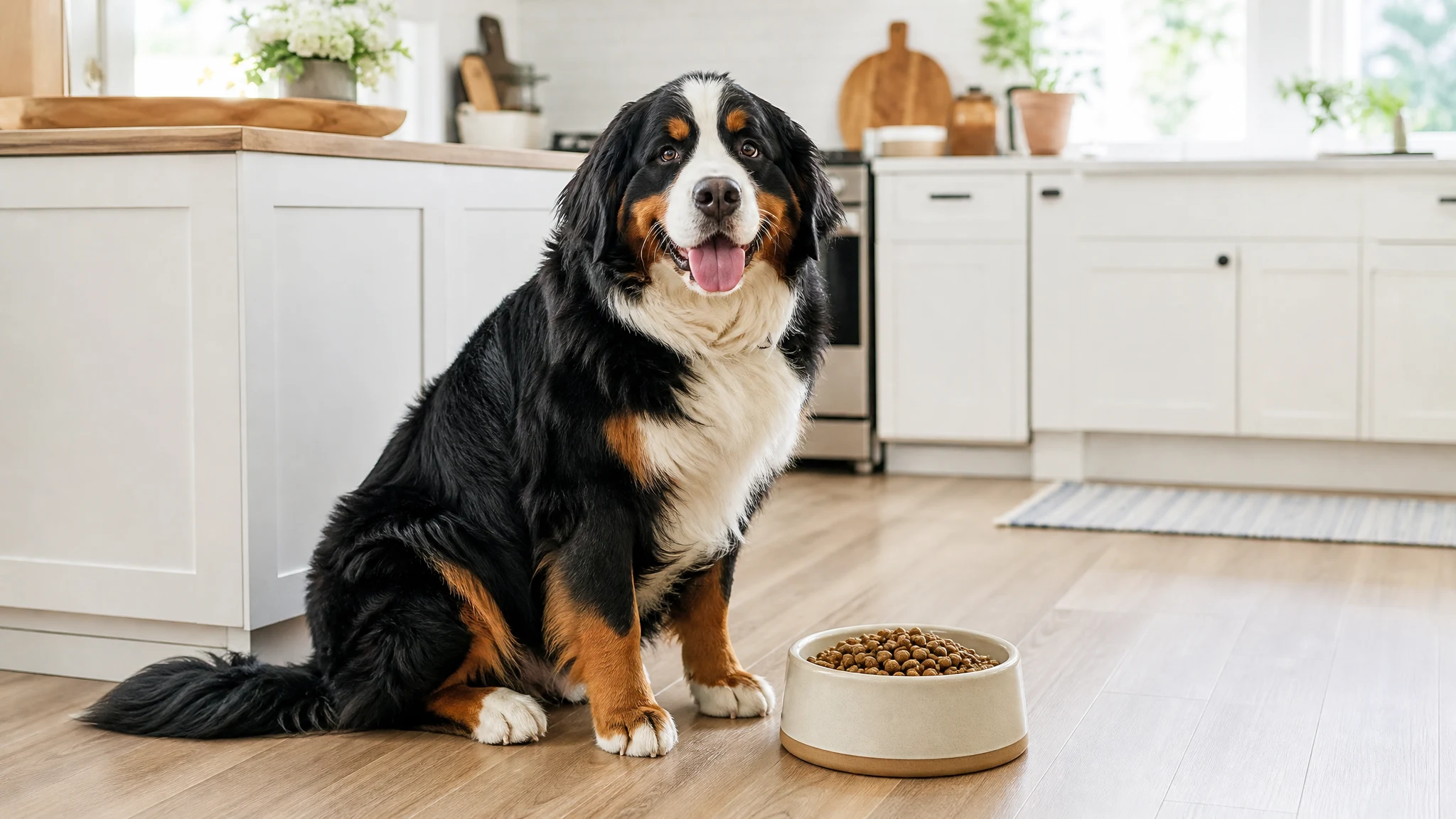
General nutrition information compiled from product labels and published sources, not veterinary advice. Your veterinarian is the right person to choose a diet for your dog, especially one with a health condition.
No single bag is the best dog food for Bernese Mountain Dogs. Every dog differs, and no brand we found makes a Bernese-specific formula. What a careful buyer can do is read labels well, match the life stage, and pick a food that suits a large, deep-chested dog.
This guide compares ten foods from Hill's Science Diet, Royal Canin, Victor and Freshpet using only what their own product pages publish. It also covers what to look for in bernese mountain dog food, which red flags to watch, and how to buy sensibly.
How we compared these foods
We compared label data. That means the AAFCO nutritional adequacy statement, the life stage, protein, fat and fiber, calories per cup, the first ingredients and kibble size, wherever the brand's page gives them.
We did not run feeding trials. We did not do taste tests. We did not feed any of these foods to dogs. Nothing here is a rating of how a food performs in a real bowl or a real dog. It is a side-by-side reading of labels, which is a fair place to start and a poor place to stop.
Three limits are worth knowing up front:
- No prices. We have no price data, so we do not rank by cost. We explain below how to work out cost per day yourself.
- Kibble size is mostly unknown. None of the dry food pages we read stated it. Check with the brand if it matters for your dog.
- Numbers are not always comparable. Hill's publishes dry matter averages, while Royal Canin, Victor and Freshpet list guaranteed minimums or maximums as fed. Fresh food holds a lot of moisture. We flag this wherever it matters.
Being listed here is not an endorsement. A food that suits one Bernese may not suit another, and a veterinarian is the right person to decide for an individual dog.
What to know about the breed before you shop
PetMD lists the Bernese Mountain Dog as a large breed, with adults at roughly 70 to 115 pounds. Wikipedia lists males at 80 to 120 pounds and females at 75 to 100 pounds. These are secondary sources, and the AKC breed page was not available to us, so treat the ranges as approximate.
PetMD gives a lifespan of 7 to 10 years. The Bernese Mountain Dog Club of America (BMDCA) health page says 7 to 8 years is too short, and that some Berners reach their teens. Diet is one piece of a long picture, and nobody can promise a number of years.
Several points from these sources bear on how you choose and serve food:
- Puppy growth. PetMD advises feeding puppies an AAFCO-compliant food designed for giant or large breeds to support steady growth, with up to four meals a day.
- Bloat risk. PetMD says deep-chested dogs, dogs fed from raised bowls and dogs fed once a day are at higher risk of gastric dilatation-volvulus (bloat). It advises two meals about 12 hours apart, a slow feeder and no elevated bowls.
- Weight and joints. For hip dysplasia, PetMD lists keeping a lean body, low-intensity exercise, omega-3s and joint supplements as part of management. Wikipedia reports elbow dysplasia prevalence of 13.91% to 26% in studies. A food label cannot treat either condition. Keeping a Bernese lean is something you do with portions and a veterinarian's guidance.
- Cancer. PetMD notes the breed is prone to several cancers, notably histiocytic sarcoma. No food claims to prevent this, and none should be trusted if it does.
The time a Bernese counts as an adult was not stated in the sources we used. Ask your veterinarian when to move from puppy food to adult food, and make the change gradually.
What to look for on a Bernese Mountain Dog food label
1. The AAFCO statement
This is the most important line on the bag. It says whether the food is complete and balanced and for which life stage. There are two common ways a food earns it. Some are formulated to meet the AAFCO Dog Food Nutrient Profiles. Others cite animal feeding tests using AAFCO procedures. The wording tells you how the claim was substantiated. It does not tell you the food is better for your dog.
2. The large-size growth wording for puppies
Whole Dog Journal explains that foods for growth or all life stages carry one of two statements. One is "including growth of large-size dogs (70 pounds or more as an adult)". The other is "except for growth of large-size dogs". The first suits large-breed puppies. The second does not.
Bernese adults weigh 70 pounds or more, so for a puppy choose the "including" wording. Do not assume it. Read the actual statement on the bag.
3. Life stage match
Puppy, adult and senior foods are built for different jobs. An "all life stages" food is allowed to meet the puppy standard, but check its large-size clause before feeding it to a Bernese puppy.
4. Calories per cup
Calories decide how much you feed, and how much you feed decides how fast a large dog gains weight. Two foods with similar protein can differ in calories per cup, so portions and cost per day differ too.
5. The first five ingredients
These tell you what the food is mostly made of by weight, before cooking. A named meat or meat meal first is easy to read. A long list of by-products or grains is not automatically bad, but read it with care. Ingredient order is a clue, not a quality score.
6. Protein, fat and fiber, read correctly
Check whether a number is a minimum, a maximum or a dry matter average. A canned or fresh food will look low in protein as fed because of its water content. Comparing across forms needs a dry matter conversion, which we do not do here.
7. Kibble size
Brands often state this on the product page or will answer by contact. Large dogs usually manage most kibble, but eating speed and chewing habits vary.
Red flags to avoid
- Claims to prevent, treat or cure disease. Food does not cure hip dysplasia, allergies, bloat, cancer or heart disease. Prescription diets are something a veterinarian prescribes, not something you pick from a shelf.
- No AAFCO statement at all, or one that does not match your dog's life stage.
- "Except for growth of large-size dogs" on a puppy food. This wording means it is not for large-breed puppies.
- A breed-specific promise you cannot verify. We found no Bernese Mountain Dog formula from any of these brands. If a bag claims one, read its AAFCO statement and ingredient list as you would for any other food.
- Guarantees. No label can guarantee your dog's health, coat or lifespan.
- Marketing words in place of data. Terms like "premium" or "natural" carry no number you can compare.
- Feeding charts you never check. The chart is a starting point. Adjust to keep your dog lean, and ask your veterinarian if unsure.
On grain-free and heart disease: the FDA has investigated a possible link between certain diets and canine dilated cardiomyopathy (DCM). Its latest update is dated 12/23/2022, and the agency says it does not intend to release further public updates until there is meaningful new scientific information. All the foods below with a stated grain status are listed as not grain-free. If you are weighing a grain-free diet, talk to your veterinarian and read the FDA page directly.
The foods side by side
The table lists what each brand's page publishes. Hill's protein, fat and fiber are dry matter averages, not guaranteed minimums. Royal Canin, Victor and Freshpet figures are minimums for protein and fat and maximums for fiber, as the brands list them.
| Food | Stage | Protein | Fat | Fiber | Calories |
|---|---|---|---|---|---|
| Hill's Science Diet Puppy Large Breed Chicken & Brown Rice (dry) | Puppy | 26.7% dry matter avg | 15.4% dry matter avg | 2.8% dry matter avg | 387 kcal/cup |
| Royal Canin Size Health Nutrition Large Puppy (dry) | Puppy | 28.0% min | 14.0% min | 3.7% max | 349 kcal/cup |
| Victor Hi-Pro Plus Large Breed Puppy (dry) | Puppy / all life stages | 30% min | 14.0% min | 6.0% max | 365 kcal/cup |
| Freshpet Multi-Protein Puppy Recipe (fresh) | Puppy | 16% min | 10% min | 2% max | 241 kcal/cup |
| Hill's Science Diet Adult Large Breed Chicken & Barley (dry) | Adult | 23.8% dry matter avg | 15% dry matter avg | 1.7% dry matter avg | 365 kcal/cup |
| Royal Canin Size Health Nutrition Large Adult (dry) | Adult | 24.0% min | 15.0% min | 3.2% max | 360 kcal/cup |
| Freshpet Large Dog Multi-Protein Recipe (fresh) | Adult | 20% min | 14% min | 1% max | 348 kcal/cup |
| Hill's Science Diet Adult 6+ Large Breed Chicken Meal, Barley & Rice (dry) | Senior (6+) | 18.7% dry matter avg | 13.5% dry matter avg | 2.4% dry matter avg | 352 kcal/cup |
| Victor Senior Healthy Weight (dry) | Senior / adult | 27.0% min | 11.5% min | 4.5% max | 360 kcal/cup |
| Hill's Science Diet Adult Chicken & Barley Entree (13 oz can) | Adult, wet | 26.7% dry matter | 16.7% dry matter | 1% dry matter | 369 kcal per can |
Do not read across rows without care. A Hill's dry matter average and a Royal Canin as-fed minimum are different kinds of numbers. Freshpet's lower percentages reflect a moist food, not necessarily less nutrition.
Picks by situation
There is no price data, so these are grouped by what your dog needs, not by cost. For each, we describe the label and who it may suit. Whether it is right for your dog is a question for your veterinarian.
Adult Bernese: three dry or fresh options
Hill's Science Diet Adult Large Breed Chicken & Barley. The AAFCO statement cites animal feeding tests using AAFCO procedures for maintenance of adult dogs. The first five ingredients are chicken, cracked pearled barley, brown rice, brewers rice and whole grain wheat. It lists 365 kcal per cup. Hill's says to adjust amounts to maintain optimal weight and to ask your veterinarian if unsure. It may suit owners who want a large-breed adult formula backed by a feeding-test statement.
Brand page: Hill's Science Diet Adult Large Breed.
Royal Canin Size Health Nutrition Large Adult. The label says it is formulated to meet the AAFCO Dog Food Nutrient Profiles for maintenance. The first five ingredients are chicken by-product meal, brewers rice, wheat, brown rice and chicken fat. It lists 24.0% minimum protein, 15.0% minimum fat and 360 kcal per cup. The feeding table runs by target adult weight and activity level, but the range given is 57 to 97 pounds. Some Berners are heavier, so confirm with the brand how to feed a dog above that range.
Brand page: Royal Canin Size Health Nutrition Large Adult.
Freshpet Large Dog Multi-Protein Recipe. A fresh food, formulated to meet AAFCO profiles for adult maintenance. The first five ingredients are chicken, egg, beef, salmon and beef liver. It lists 20% minimum protein, 14% minimum fat and 348 kcal per cup. The page's sample feeding line is for dogs of 51 to 65 pounds, at 2 1/2 to 3 cups a day, as one meal or split into two. A Bernese is usually heavier, so use the brand's chart for your dog's actual weight. Splitting into two meals fits PetMD's bloat advice. Whether the grain status suits you is unknown from the page, so check with the brand.
Brand page: Freshpet Large Dog Multi-Protein Recipe.
Bernese puppy
The label detail to find is the large-size growth wording. Three of the four puppy foods below show it or something close. One needs a check.
Hill's Science Diet Puppy Large Breed Chicken & Brown Rice. Dry. The statement says animal feeding tests using AAFCO procedures substantiate complete and balanced nutrition for growing puppies. The page fragments we read did not show a full statement, so read the bag or the page for any large-size clause. First five ingredients: chicken, brown rice, whole grain oats, chicken meal and cracked pearled barley. It lists 387 kcal per cup, the highest of the group, so measure carefully.
Brand page: Hill's Science Diet Puppy Large Breed.
Royal Canin Size Health Nutrition Large Puppy. Dry, for puppies up to 15 months with an expected adult weight of 56 to 100 pounds. It is formulated to meet AAFCO profiles for growth, including growth of large-size dogs. First five ingredients: chicken by-product meal, corn, wheat, chicken fat and wheat gluten. It lists 28.0% minimum protein, 14.0% minimum fat and 349 kcal per cup. Because many Berners finish above 100 pounds, ask the brand whether the feeding guide and age limit fit your puppy. The brand has a feeding calculator, and its chart is an image.
Brand page: Royal Canin Size Health Nutrition Large Puppy.
Victor Hi-Pro Plus Large Breed Puppy. Dry. The statement is for AAFCO profiles for All Life Stages. The large-size clause was not visible in what we read, so check the bag for the wording before choosing it for a Bernese puppy. First five ingredients: chicken, chicken meal, brown rice, whole grain millet and whole grain sorghum. It lists 30% minimum protein, 14.0% minimum fat, a 6.0% maximum fiber and 365 kcal per cup. Victor says that after age one, you should feed to maintain good body condition using the chart as a guide.
Brand page: Victor Hi-Pro Plus Large Breed Puppy.
Freshpet Multi-Protein Puppy Recipe With Green Beans & Carrots. Fresh. Its statement is for growth including growth of large size dogs (70 pounds or more as an adult), which is the wording Whole Dog Journal says to look for. First five ingredients: chicken, eggs, beef, beef liver and green beans. It lists 16% minimum protein, 10% minimum fat and 241 kcal per cup. Freshpet says it can be fed as one meal daily or split into two. For a growing Bernese, PetMD's advice is more meals, up to four a day, so ask your veterinarian how to divide the portions.
Brand page: Freshpet Multi-Protein Puppy Recipe.
Senior Bernese
Hill's Science Diet Adult 6+ Large Breed Chicken Meal, Barley & Rice. Dry, for large-breed dogs aged six and over. The statement cites animal feeding tests using AAFCO procedures, and the page continues with complete and balanced nutrition for adult maintenance. First five ingredients: chicken meal, cracked pearled barley, brewers rice, whole grain wheat and whole grain corn. It lists 352 kcal per cup, the lowest of the Hill's dry foods, and dry matter averages of 18.7% protein and 13.5% fat. The page's example chart gives 3 cups for a 50 pound dog and 4 3/4 cups for a 100 pound dog. That is a guide, not a prescription.
Brand page: Hill's Science Diet Adult 6+ Large Breed.
Given the breed's lifespan range, "senior" can arrive early for a Bernese. Your veterinarian can tell you when the switch makes sense for your dog.
Weight control
Victor Senior Healthy Weight. Dry, a general senior weight-management formula, not a large-breed one. The statement is for AAFCO profiles for adult maintenance. First five ingredients: beef meal, whole grain brown rice, whole grain millet, grain sorghum and chicken fat. It lists 27.0% minimum protein, 11.5% minimum fat, 4.5% maximum fiber and 360 kcal per cup.
The fat minimum is the lowest of the dry foods we compared, but the calories per cup are close to the others. That is a good reminder that calories per cup, not the product name, drives weight. Victor's page gives a rule for dogs over 100 pounds: increase the amount by 1/2 cup for every 20 pounds over 100. That suits a big Bernese, but start from the chart and adjust with your veterinarian's help.
Brand page: Victor Senior Healthy Weight.
Whatever food you use, PetMD lists a lean body as part of managing hip dysplasia. Measuring portions, rather than guessing, is the simplest tool you have.
Sensitive stomach
None of the foods we compared is labeled by its brand as a sensitive stomach formula, so we cannot point to a pick here. Stomach upset has many causes, and some need veterinary attention. If your Bernese has ongoing digestive trouble, see your veterinarian. They may suggest a diet trial or a prescription diet, which only a veterinarian can prescribe.
If you are changing foods for any reason, do it gradually and follow the brand's or your veterinarian's advice on timing.
Wet food and toppers
Hill's Science Diet Adult Chicken & Barley Entree (13 oz can). Wet. It is a general adult formula, not a large-breed one, and the page says it is not for puppies or mature adults. The statement cites animal feeding tests for adult maintenance. First five ingredients: water, chicken, pork liver, whole grain corn and cracked pearled barley. It lists 369 kcal per 13 ounce can, with dry matter figures of 26.7% protein, 16.7% fat and 1% fiber.
Hill's maintenance amounts run from 1/2 can a day for a 5 pound dog to 6 cans a day for a 120 pound dog. A can is calorie-dense, so if you add some to dry food, reduce the dry portion to match. This can suit owners who want to add moisture and variety, but do the math before you pour.
Brand page: Hill's Science Diet Adult Chicken & Barley Entree.
Fresh food
Freshpet is the only fresh brand in our data. Both Freshpet foods above are covered in the adult and puppy sections. Fresh food has a lower calorie count per cup than dry, so a large dog may need a lot of volume. Check the brand's chart against your dog's weight, and ask the brand about storage and how it ships or stocks.
What this comparison cannot tell you
Label data is useful but narrow. It cannot tell you how digestible a food is, how a dog will take to it, or how it will affect your dog's weight over months. It also cannot tell you about a brand's quality control or recall record, which we did not research and do not report.
For those questions, talk to your veterinarian and read the brand's own pages. If a detail matters to you, such as kibble size or the full AAFCO wording, contact the brand and ask.
Where to buy
Each brand's own product page, linked above, is the right starting point. It shows the current label, the ingredient list and the feeding guide, and it is where you can confirm the AAFCO statement before you commit to a large bag. Ask the brand which stores or delivery options carry the food near you, or check with your veterinarian's office.
Whichever route you choose:
- Check the AAFCO statement on the bag in your hands, not just the one online.
- Look for a best-by date and an undamaged bag.
- Start with a small bag if you are trying a new food.
- Work out cost per day, since we have no price data. Divide the bag price by the number of days it lasts at your dog's feeding amount. Calories per cup tells you how many cups your dog will need.
Feeding habits that matter as much as the brand
PetMD's bloat advice is practical and costs nothing: feed two meals about 12 hours apart, use a slow feeder, and avoid elevated bowls. Treats and toppers count toward daily calories. For puppies, PetMD advises up to four meals a day to support steady growth.
Weigh your dog on a schedule and ask your veterinarian to judge body condition. A lean Bernese is the goal. Feeding charts are starting points, and your dog may need more or less.
A short checklist
- Find the AAFCO statement and confirm it matches your dog's life stage.
- For a puppy, confirm the "including growth of large-size dogs (70 pounds or more as an adult)" wording.
- Compare calories per cup, then work out the daily amount for your dog's weight.
- Read the first five ingredients and note anything you want to ask about.
- Check whether the protein and fat numbers are minimums or dry matter averages before comparing.
- Ask your veterinarian before changing foods for any health reason.
- Ask the brand about anything the page does not say, such as kibble size.
Sources
- PetMD, Bernese Mountain Dog breed page
- Bernese Mountain Dog Club of America, health page
- Whole Dog Journal, In the Fine Print: Nutritional Adequacy Statements
- FDA Center for Veterinary Medicine, investigation into diets and canine dilated cardiomyopathy
- Wikipedia, Bernese Mountain Dog (secondary)
- Hill's Science Diet Puppy Large Breed
- Hill's Science Diet Adult Large Breed
- Hill's Science Diet Adult 6+ Large Breed
- Hill's Science Diet Adult Chicken & Barley Entree
- Royal Canin Size Health Nutrition Large Puppy
- Royal Canin Size Health Nutrition Large Adult
- Victor Hi-Pro Plus Large Breed Puppy
- Victor Senior Healthy Weight
- Freshpet Large Dog Multi-Protein Recipe
- Freshpet Multi-Protein Puppy Recipe With Green Beans & Carrots