Golden Bernese Mountain Dog Mixes: Temperament and Size
General nutrition information compiled from product labels and published sources, not veterinary advice. Your veterinarian is the right person to choose a diet for your dog, especially one with a health condition.
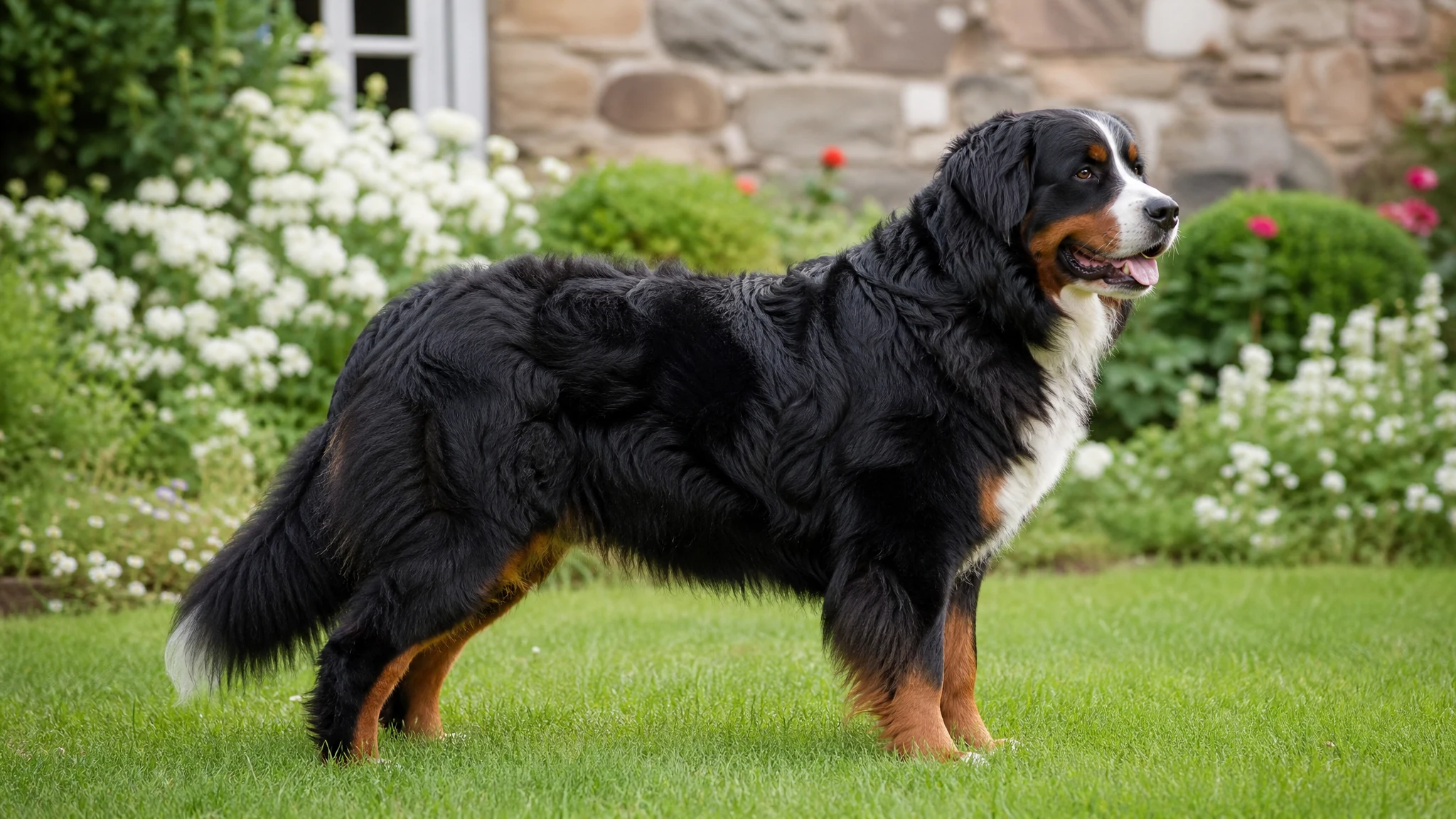
A golden Bernese Mountain Dog mix is a cross between a Bernese Mountain Dog and a golden-coated parent, most often a Golden Retriever. Mixed-breed puppies vary a lot. Two pups from one litter can differ in size, coat and energy.
This guide shows you how to size up a golden Bernese Mountain Dog mix and build a feeding plan around that estimate. It does not promise a particular result. It gives you a method you can repeat with your own dog and your own veterinarian.
What We Can and Cannot Say About This Mix
There is no breed standard for a golden Bernese Mountain Dog mix. We did not find a club or registry that publishes expected adult weight or temperament for the cross. So any exact number you see for this mix should be treated with caution.
What we can cite is the Bernese side. PetMD lists the Bernese Mountain Dog as a large breed, with adults at roughly 70 to 115 pounds. Wikipedia gives a slightly different split: males 80 to 120 pounds and females 75 to 100 pounds. The sources differ a little, which is normal.
For the other parent, check the Golden Retriever Club of America or the American Kennel Club. For temperament and size in your specific puppy, ask the breeder for the weights and health records of both parents.
What You Need Before You Start
- The adult weights of both parents, if the breeder can share them.
- Your puppy's current weight, measured on the same scale each time.
- A notebook or phone note for weight, meals and stool quality.
- A measuring cup or kitchen scale.
- A slow feeder bowl that sits on the floor.
- The food bag or can, so you can read the full label.
- Your veterinarian's contact details for growth checks.
Step 1: Estimate Adult Size as a Range, Not a Number
Start with the parents. If both are large, plan for a large dog. A mix can land closer to either parent, so treat any estimate as a range and expect to revise it.
Ask your veterinarian to track growth at each puppy visit. They can compare your puppy's weight curve to what they see in similar dogs. Do not rely on a paw-size rule or an online calculator as a final answer.
Why it matters: the size estimate decides which puppy food label you need in Step 3.
Step 2: Set Your Temperament Expectations Honestly
Temperament in a mix is also a range. Meet the parents if you can. Watch how they handle strangers, noise and handling. Those observations tell you more than a breed label does.
Whatever the mix, use humane, reward-based training, in line with the American Veterinary Society of Animal Behavior. Use treats, praise and short sessions. Avoid shock, prong or choke collars, alpha rolls, scruffing and dominance methods.
Food connects to training here. Small, measured treats count toward the day's calories, which helps you keep a lean body. Keep that in mind when you plan portions.
Step 3: Choose Puppy Food by Its Label Wording
If your puppy may reach 70 pounds or more as an adult, the label wording matters. The Whole Dog Journal explains that foods for growth or all life stages carry one of two kinds of statement. One says the food supports growth "including growth of large-size dogs (70 pounds or more as an adult)." The other says "except for growth of large-size dogs," which means it is not for large-breed puppies.
PetMD advises feeding Bernese puppies an AAFCO-compliant food designed for giant or large breeds, to support steady growth.
Here is what the label data shows for several large-breed puppy foods. We compared label data from the brands' own pages. We did not run feeding trials or taste tests, and this is not a ranking.
| Food | Form | Calories | Label notes |
|---|---|---|---|
| Hill's Science Diet Puppy Large Breed Chicken & Brown Rice | Dry | 387 kcal per cup | Large breed puppy formula. First ingredient chicken. Protein and fat are listed as dry matter averages (26.7 and 15.4), not minimums. |
| Royal Canin Size Health Nutrition Large Puppy | Dry | 349 kcal per cup | For puppies up to 15 months with an adult weight of 56 to 100 pounds. Minimum protein 28 percent, minimum fat 14 percent. First ingredient chicken by-product meal. |
| Freshpet Multi-Protein Puppy Recipe | Fresh | 241 kcal per cup | Statement covers growth including large size dogs (70 pounds or more as an adult). Minimum protein 16 percent, minimum fat 10 percent. |
| Victor Hi-Pro Plus Large Breed Puppy | Dry | 365 kcal per cup | All life stages statement. We could not confirm its large-size clause, so read the bag or ask the brand. |
None of these is made for Bernese Mountain Dogs or for this mix. We found no breed-specific formula. For a wider look at adult and senior options, see our comparison of foods for Bernese Mountain Dogs.
Step 4: Use the Feeding Guide as a Starting Point
Brand feeding charts are starting points. Hill's says to adjust amounts as necessary to maintain optimal weight and to ask your veterinarian if you are unsure. Royal Canin offers a feeding calculator on its product page.
Measure each meal. Write down the amount and your puppy's weight every week or two. If growth looks too fast or your puppy looks round, ask your veterinarian before changing the amount yourself.
Why it matters: PetMD notes that keeping a lean body is part of managing hip dysplasia in Bernese Mountain Dogs. The same sensible habit applies to a mix with a Bernese parent. A veterinarian decides what is right for an individual dog.
Step 5: Set Up Meals to Lower Bloat Risk
PetMD says deep-chested dogs, dogs fed from raised bowls and dogs fed once a day are at higher risk of gastric dilatation-volvulus, also called bloat. Its advice is two meals about 12 hours apart, a slow feeder and no elevated bowls.
PetMD also says puppies can eat up to four meals a day. Ask your veterinarian how to space them as your puppy grows. Food does not prevent bloat, so learn the signs of an emergency and know where your nearest emergency clinic is.
Step 6: Plan the Move to Adult Food
We did not find a source that states when a Bernese Mountain Dog is considered an adult. Ask your veterinarian when to switch. Royal Canin's large puppy formula is listed for puppies up to 15 months, which gives one brand's reference point.
When you switch, mix the new food into the old over several days. Watch stools and appetite. Check the adult label for wording like "formulated to meet the nutritional levels established by the AAFCO Dog Food Nutrient Profiles for maintenance."
Tips
- Weigh your puppy on one scale at regular intervals. A trend tells you more than one reading.
- Read the whole label, not just the front of the bag. The nutritional adequacy statement is in the fine print.
- Count treats and training rewards as part of daily calories.
- Keep exercise gentle and low-impact while your puppy is growing, and ask your veterinarian what suits your dog.
- Ask about health screening. PetMD says Bernese Mountain Dogs are prone to several cancers, notably histiocytic sarcoma. Wikipedia reports elbow dysplasia prevalence of 13.91 to 26 percent in studies. A mix may or may not share these risks, so talk to your veterinarian.
- On grain-free diets and heart disease, the FDA's latest update on its investigation into diets and canine dilated cardiomyopathy is dated 12/23/2022. The FDA says it does not plan more public updates until there is meaningful new scientific information. Ask your veterinarian about it.
Common Mistakes to Avoid
- Assuming a fixed adult size. Mixes vary, so keep your estimate flexible.
- Using an adult or general puppy food. Look for the "including growth of large-size dogs" wording, not "except for."
- Feeding once a day from a raised bowl. PetMD flags both as bloat risk factors.
- Copying a bag's chart without adjusting. The chart is a start. Body condition and your veterinarian's advice come next.
- Adding supplements on your own. PetMD mentions omega-3s and joint supplements for hip dysplasia management, but do not add any without your veterinarian choosing the product and amount.
- Treating the food as a medical tool. No food cures or prevents a disease. Only a veterinarian can prescribe a prescription diet.
What Results to Expect
With a steady routine, many owners find that weight tracking and measured meals make growth easier to follow. Your puppy may show a smooth weight curve and consistent stools, though every dog differs.
On the Bernese side, the Bernese Mountain Dog Club of America says a lifespan of 7 to 8 years is too short and that some Berners reach their teens. PetMD gives 7 to 10 years. Lifespan for the mix is not something we can predict.
Keep your veterinarian involved at each step. Good habits may help you spot changes early, but they do not guarantee any outcome.
Sources
- PetMD, Bernese Mountain Dog breed page
- Bernese Mountain Dog Club of America, health page
- Whole Dog Journal, nutritional adequacy statements
- Wikipedia, Bernese Mountain Dog
- FDA CVM, diets and canine dilated cardiomyopathy
- Hill's Science Diet Puppy Large Breed
- Royal Canin Size Health Nutrition Large Puppy
- Freshpet Multi-Protein Puppy Recipe
- Victor Hi-Pro Plus Large Breed Puppy