Best Training Treats for Bernese Mountain Dogs (and How Many to Give)
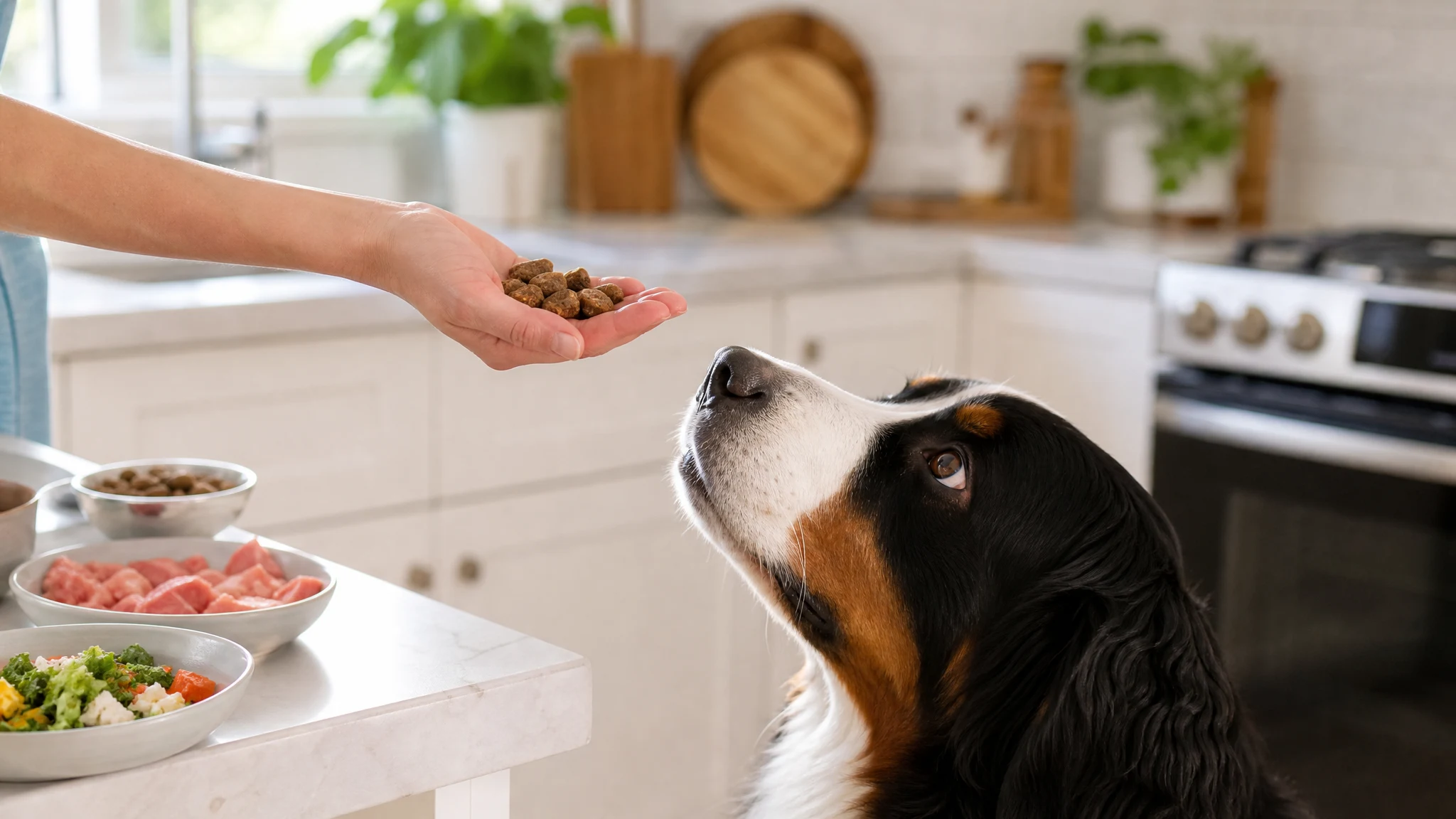
General nutrition information compiled from product labels and published sources, not veterinary advice. Your veterinarian is the right person to choose a diet for your dog, especially one with a health condition.
Training treats for Bernese Mountain Dogs need to do three jobs. They have to be tasty enough to earn attention, small enough to give by the dozen, and light enough not to push a big dog toward extra weight.
This guide walks through choosing the best treats for Bernese Mountain Dogs by category, sizing them, and fitting them into a daily calorie budget. We did not taste-test or feed-trial any treats. The advice here comes from published label practice, general calorie guidance and breed information from PetMD.
Why treats need extra thought for this breed
PetMD describes the Bernese Mountain Dog as a large breed, with adults commonly listed at 70 to 115 lb. A dog that size can eat a lot of treats without anyone noticing, because each one looks tiny next to the dog.
Weight matters here. For hip dysplasia, PetMD lists keeping a lean body among the management steps. PetMD also notes that the breed is prone to several cancers, notably histiocytic sarcoma. No treat prevents or treats any of these conditions. The practical point is simpler: treat calories add up, and a veterinarian is the right person to judge what a healthy weight looks like for your individual dog.
Berners are also known as people-pleasing, food-motivated learners, so treats work well. That makes portion control the part that needs care.
Materials you will need
- Two or three treat types. One high-value option for hard tasks, one everyday option, and one low-calorie option.
- A treat pouch or small container you can reach with one hand.
- A kitchen scale or measuring spoons. These are for building the daily treat allowance.
- The calorie numbers from each treat package. Many treat labels list kcal per treat or per kilogram. If a label does not show it, contact the brand.
- Your dog's daily calorie target from your veterinarian.
- A cutting board and knife for shrinking treats.
The three treat categories worth knowing
We are not naming specific treat brands, because we have no label data to compare for treats. Here is how the categories differ, so you can read labels yourself.
Soft training treats
These are moist, pliable and easy to break into tiny pieces. They are quick to swallow, which keeps a training session moving. Check the label for calories per treat, since some soft treats are fairly dense. Look at the ingredient list too, and be skeptical of front-of-bag claims. Marketing words like "premium" or "natural" are not label facts.
Freeze-dried single-protein treats
These contain one animal ingredient, such as a single meat. They are strongly scented, which helps for distractions like a busy park. The short ingredient list also makes it easy to see what your dog is eating, which is handy if your veterinarian ever asks you to keep a close eye on ingredients. They crumble easily, so you can snap them into small bits.
Vegetables
Some dogs accept small pieces of plain vegetables as a low-calorie reward. These are useful as a bulk filler in a day with lots of training. Ask your veterinarian which vegetables are appropriate for your dog, and introduce any new food slowly. Not every dog finds vegetables exciting, so keep them for easy cues rather than hard ones.
Your dog's own food
Do not overlook the bowl. Pulling kibble out of the daily ration is an easy way to reward without adding calories. For comparison, the Hill's Science Diet Adult Large Breed dry food lists 365 kcal per cup, and the Royal Canin Size Health Nutrition Large Puppy lists 349 kcal ME per cup, both on the brands' own pages. Our comparison of foods for Bernese Mountain Dogs covers more label data.
Step-by-step: building a treat plan
Step 1: Ask your veterinarian for a daily calorie target
Daily needs vary with age, activity, body condition and neutering status. Your veterinarian can give a number for your dog. Food brands also publish feeding guides, which are best treated as starting points. For example, Hill's says to adjust amounts as needed to maintain optimal weight, and to ask your veterinarian if you are unsure.
Step 2: Apply the 10 percent rule
A commonly cited guideline, including in World Small Animal Veterinary Association (WSAVA) guidance, is that treats should make up no more than about 10 percent of daily calories. The rest should come from a complete and balanced diet.
Here is the math, using a made-up figure just to show the steps. Suppose your veterinarian says a dog needs 1,500 calories a day. Ten percent is 150 calories for all treats combined. Your actual number will differ, so use your own dog's target.
Many people think of 10 percent as the ceiling, not the goal. On lighter days, or if your dog is gaining weight, use less.
Step 3: Find the calories per treat
Read the package for kcal per treat, or kcal per kilogram. If it only gives kcal per kilogram, divide by the number of treats per kilogram or weigh a handful and work it out. If you cannot find the number, check with the brand before relying on the product for daily training.
Step 4: Count out the day's treats
Divide your treat calorie budget by calories per treat. That tells you how many full-size treats you could give. Then multiply by the number of pieces each treat can be cut into. This is where Bernese Mountain Dog treats can go a long way.
Step 5: Cut treats down to the right size
For this breed, think small. A pea-sized or smaller piece is plenty for most cues. A large dog does not need a large treat. It needs a fast reward, so the dog learns what earned it and the session keeps moving. Cut soft treats with a knife, and snap freeze-dried pieces into crumbs. Bigger pieces take longer to chew and slow down training.
Step 6: Reward right away, with humane methods
Deliver the treat within a second or two of the behavior you want. Reward-based training is what the American Veterinary Society of Animal Behavior (AVSAB) supports. Do not use shock, prong or choke collars, or any dominance-style methods. Treats, praise and play are enough to teach the basics.
Step 7: Mix your treat types
Use the high-value treat for new or difficult tasks, the soft everyday treat for routine practice, and vegetables or pieces of kibble for easy repeats. Mixing keeps your dog interested and lowers the average calories per reward.
Step 8: Subtract treats from meals if needed
If you used a lot of treats in a session, take a little out of the next meal. Do this by measuring, not guessing. Ask your veterinarian before making large changes.
Step 9: Watch body condition and adjust
Check your dog's shape every few weeks. You should be able to feel the ribs under a thin layer of padding. If you are unsure, ask your veterinarian to show you what to look for. Adjust the treat budget based on what you see.
Puppy notes
PetMD advises feeding Bernese puppies an AAFCO-compliant food designed for giant or large breeds, to support steady growth, with up to four meals a day. Treats should stay a small part of the day for puppies too.
When choosing the main puppy food, Whole Dog Journal explains the label wording to look for: "including growth of large-size dogs (70 pounds or more as an adult)." A statement that says "except for" growth of large-size dogs means the food is not meant for large-breed puppies. Bernese adults weigh 70 lb or more, so the "including" wording is the one to look for. For specific treat questions, check with your veterinarian and the treat brand.
Tips for better sessions
- Keep sessions short. Several short sessions a day usually work better than one long one.
- Train before meals, not after. A slightly hungry dog is often more interested. Do not skip meals to make this happen.
- Keep treats low-key near mealtimes. PetMD notes that deep-chested dogs, dogs fed once a day and dogs fed from raised bowls are at higher risk of bloat (gastric dilatation-volvulus), and advises two meals about 12 hours apart, a slow feeder and no elevated bowls. Ask your veterinarian how treats and exercise should fit around meals for your dog.
- Introduce one new treat at a time. If your dog has a stomach upset, you will know the cause.
- Keep a pouch ready. Planned rewards are easier to count than handfuls from a bag.
- Read the whole ingredient list. The FDA has investigated a possible link between certain diets and canine dilated cardiomyopathy. Its most recent update is dated 12/23/2022, and it says it does not plan more public updates until there is meaningful new scientific information. If you have questions about ingredients, ask your veterinarian.
Common mistakes to avoid
- Not counting treats at all. Small pieces still add calories, especially across a whole day of practice.
- Giving large pieces. A big treat does not teach faster. It just uses more of the budget.
- Using only high-calorie treats. Save the richest options for the hardest moments.
- Feeding table scraps as rewards. They are hard to measure and may not suit your dog. Ask your veterinarian what is safe.
- Treating from the hand when the dog is jumping. This rewards the jumping. Wait for four paws on the floor.
- Forgetting extra treats from other people. Tell family and friends the daily limit.
- Choosing treats by marketing claims. Front-label words are not nutrition information. Read the calories and ingredients.
- Using treats for medical purposes. Treats do not treat or prevent any condition. A veterinarian decides diet changes for an individual dog.
What to expect
With consistent timing and small, appealing rewards, many dogs learn simple cues like sit and down within a few weeks. Results vary with age, temperament and how often you practice, so treat any timeline as a rough guide.
A calorie-aware treat plan may also make it easier to keep your dog at a healthy weight, which your veterinarian can confirm at check-ups. It can reduce the guesswork on busy days. It cannot promise any health outcome.
How we approached this
This is a how-to guide, not a product review. We compared label practices and published breed information. We did not run feeding trials or taste tests, and we have not named treat products because we have no label data on them. When you shop, compare the calories, ingredients and the brand's own information.