Bernese Mountain Dog x Australian Shepherd Mix: Temperament and Feeding Needs
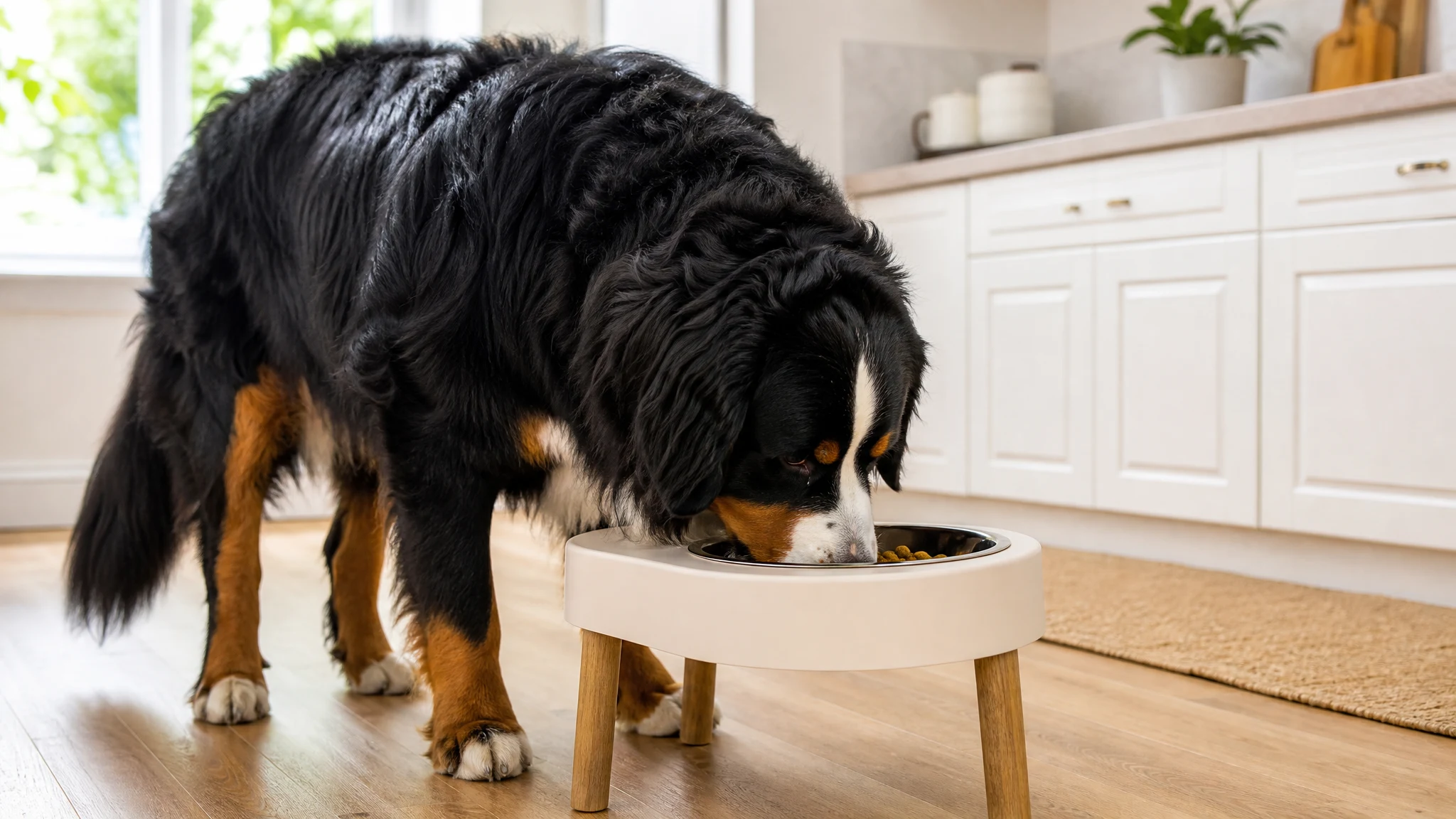
General nutrition information compiled from product labels and published sources, not veterinary advice. Your veterinarian is the right person to choose a diet for your dog, especially one with a health condition.
An Australian Shepherd Bernese Mountain Dog mix is a crossbreed, so no one can promise how a given puppy will turn out. Size, coat, energy and appetite can lean toward either parent.
This guide shows you how to build a feeding plan around that uncertainty. It starts with the parts of the Bernese side that sources do document, then walks through choosing a food, setting meals and watching your dog's body condition.
We compared label data from brand pages. We did not run feeding trials or taste tests, and nothing here replaces your veterinarian's advice for your individual dog.
What to Know About Temperament Before You Feed
Temperament in a mixed-breed dog is hard to predict. The Bernese Mountain Dog and the Australian Shepherd were bred for different jobs, and a mix can inherit any blend of traits.
We do not have a reliable source describing the temperament of this specific cross. For parent-breed traits, check with the Bernese Mountain Dog Club of America and the Australian Shepherd national club, or ask the breeder or rescue about the actual parents.
Why does this matter for food? Because activity level changes calorie needs. A calm, couch-loving dog and a restless, busy one can need quite different amounts, even at the same weight. Watch your own dog rather than assuming.
Materials Needed
- A kitchen or postal scale to weigh your dog's food and, for smaller dogs, your dog
- A standard measuring cup
- A slow-feeder bowl set at floor level
- The bag or can of food you are considering, with its nutritional adequacy statement visible
- A notebook for weight, meals and stool quality
- Your veterinarian's contact details for questions about your dog's health
Step 1: Estimate Your Dog's Likely Adult Size
Food choice depends heavily on expected adult weight. PetMD describes the Bernese Mountain Dog as a large breed, with adults around 70 to 115 pounds. Wikipedia lists males at 80 to 120 pounds and females at 75 to 100 pounds.
A mix may land below that range. An Australian Shepherd parent often means a smaller frame, but we cannot say by how much for your dog.
Ask your veterinarian to estimate adult size from your puppy's growth. If the estimate is 70 pounds or more, treat your dog as a large-breed puppy for feeding purposes.
Step 2: Match the Label to the Life Stage
Turn the bag over and find the nutritional adequacy statement. For puppies, Whole Dog Journal explains that foods for growth or all life stages carry one of two kinds of wording.
- "Including growth of large-size dogs (70 pounds or more as an adult)" means the food is suitable for large-breed puppies.
- "Except for growth of large-size dogs" means it is not.
PetMD advises feeding Bernese puppies an AAFCO-compliant food designed for giant or large breeds to support steady growth. If your mix is likely to pass 70 pounds, choose the "including" wording.
For adults, look for a statement of nutritional levels for maintenance. For seniors, ask your veterinarian when to switch.
Step 3: Compare a Few Label-Based Options
No Bernese-specific formula turned up in our research, so the realistic choice is a large-breed formula. The table lists label data from the brands' own pages.
| Food | Stage | Label detail |
|---|---|---|
| Hill's Science Diet Puppy Large Breed Chicken & Brown Rice | Large-breed puppy | 387 kcal per cup; chicken is the first ingredient |
| Royal Canin Size Health Nutrition Large Puppy | Large-breed puppy, adult weight 56 to 100 lb | 349 kcal per cup; 28% minimum protein, 14% minimum fat |
| Freshpet Multi-Protein Puppy Recipe | Puppy, including large-size dogs | 241 kcal per cup; statement names dogs 70 pounds or more as adults |
| Hill's Science Diet Adult Large Breed Chicken & Barley | Adult | 365 kcal per cup; chicken is the first ingredient |
| Royal Canin Size Health Nutrition Large Adult | Adult, target weight 57 to 97 lb | 360 kcal per cup; 24% minimum protein, 15% minimum fat |
Hill's publishes dry matter averages rather than guaranteed minimums, so its protein and fat figures are not directly comparable with Royal Canin's minimums. For ingredient lists, kibble size and the full statements, go to each brand's page. For a wider look, see our comparison of foods for Bernese Mountain Dogs.
Step 4: Set a Starting Amount From the Label
Feeding charts on the bag or brand page are starting points. They are based on weight, and some also consider age and activity.
- Weigh your dog, or use your veterinarian's most recent weight.
- Find that weight on the brand's feeding chart or calculator. Royal Canin offers a calculator on its product pages.
- Measure the daily amount with a standard cup or a scale.
- Split it into meals (see Step 5).
- Adjust over two to three weeks based on body condition.
For reference, Hill's chart for its Adult 6+ Large Breed food lists 3 cups a day for a 50 pound dog and 4 3/4 cups for a 100 pound dog. Hill's tells owners to adjust amounts to maintain optimal weight and to ask a veterinarian if unsure.
Freshpet's large dog recipe lists 2 1/2 to 3 cups a day for dogs weighing 51 to 65 pounds. Calories per cup differ widely between foods, so never carry a cup measurement from one food to another.
Treats and toppers count toward the day's calories. Reduce meals slightly if you use many.
Step 5: Plan Meals to Lower Bloat Risk
Bloat, or gastric dilatation-volvulus, is a serious concern for deep-chested dogs. PetMD says deep-chested dogs, dogs fed from raised bowls and dogs fed once a day are at higher risk.
For Bernese dogs, PetMD advises two meals about 12 hours apart, a slow feeder and no elevated bowls. A mix with a deep chest may share this risk, so it is sensible to follow the same habits.
For puppies, PetMD says up to four meals a day is appropriate. Move to two meals as your veterinarian advises. Ask your veterinarian what to watch for, and what to do if your dog's belly looks swollen or your dog retches without producing anything.
Step 6: Track Body Condition
PetMD lists keeping a lean body as part of managing hip dysplasia in Bernese dogs. Wikipedia reports elbow dysplasia studies with prevalence between 13.91% and 26% in the breed. A mix may or may not share these tendencies, and food does not prevent or treat either condition.
What you can do is keep your dog at a healthy weight. Every two weeks, feel along the ribs and look from above for a waist. Write down weight and any changes in appetite or stool.
Tips
- Switch foods gradually, mixing old and new over about a week, unless your veterinarian says otherwise.
- Keep the same large-breed formula through growth rather than switching often.
- Read the whole ingredient list, not only the front of the bag.
- Be skeptical of marketing words like "natural" or "premium." The adequacy statement tells you more.
- On grain-free foods, the FDA's page on its investigation into diets and canine dilated cardiomyopathy shows the latest update dated 12/23/2022. The FDA says it does not plan further public updates until there is meaningful new scientific information. Ask your veterinarian whether it matters for your dog.
Common Mistakes to Avoid
- Using an adult food for a growing puppy. Check for the "including growth of large-size dogs" wording.
- Feeding once a day. PetMD links this to higher bloat risk.
- Using a raised bowl. PetMD advises against elevated bowls for Bernese dogs.
- Treating the chart as a rule. It is a starting point.
- Adding joint supplements on your own. Ask your veterinarian first. We give no supplement doses, and any amount should come from your veterinarian.
- Assuming a mix is healthier by default. Ask your veterinarian about screening for the parent breeds' known concerns.
Expected Results
With steady meals, a suitable large-breed formula and regular weigh-ins, many owners find their dogs keep a lean, comfortable body condition. Results vary, and a good plan may help but cannot guarantee any outcome.
You may see steady growth in a puppy, or stable weight in an adult. Firm stools and consistent appetite are good signs. If your dog loses weight, gains quickly, or seems unwell, call your veterinarian.
If your dog has a health condition, confirm all amounts and food choices with your veterinarian first. Prescription diets are only something a veterinarian can prescribe.
Lifespan sources differ. PetMD gives 7 to 10 years for Bernese dogs, while the Bernese Mountain Dog Club of America says 7 to 8 years is too short and that some reach their teens. A mix's lifespan is not documented in these sources.
Sources
- PetMD, Bernese Mountain Dog breed page
- Bernese Mountain Dog Club of America, health page
- Whole Dog Journal, nutritional adequacy statements
- FDA Center for Veterinary Medicine, diets and canine dilated cardiomyopathy
- Wikipedia, Bernese Mountain Dog
- Hill's Pet, Science Diet Puppy Large Breed
- Royal Canin, Large Puppy
- Freshpet, Multi-Protein Puppy Recipe