Wet vs Dry vs Fresh Food for Bernese Mountain Dogs
General nutrition information compiled from product labels and published sources, not veterinary advice. Your veterinarian is the right person to choose a diet for your dog, especially one with a health condition.
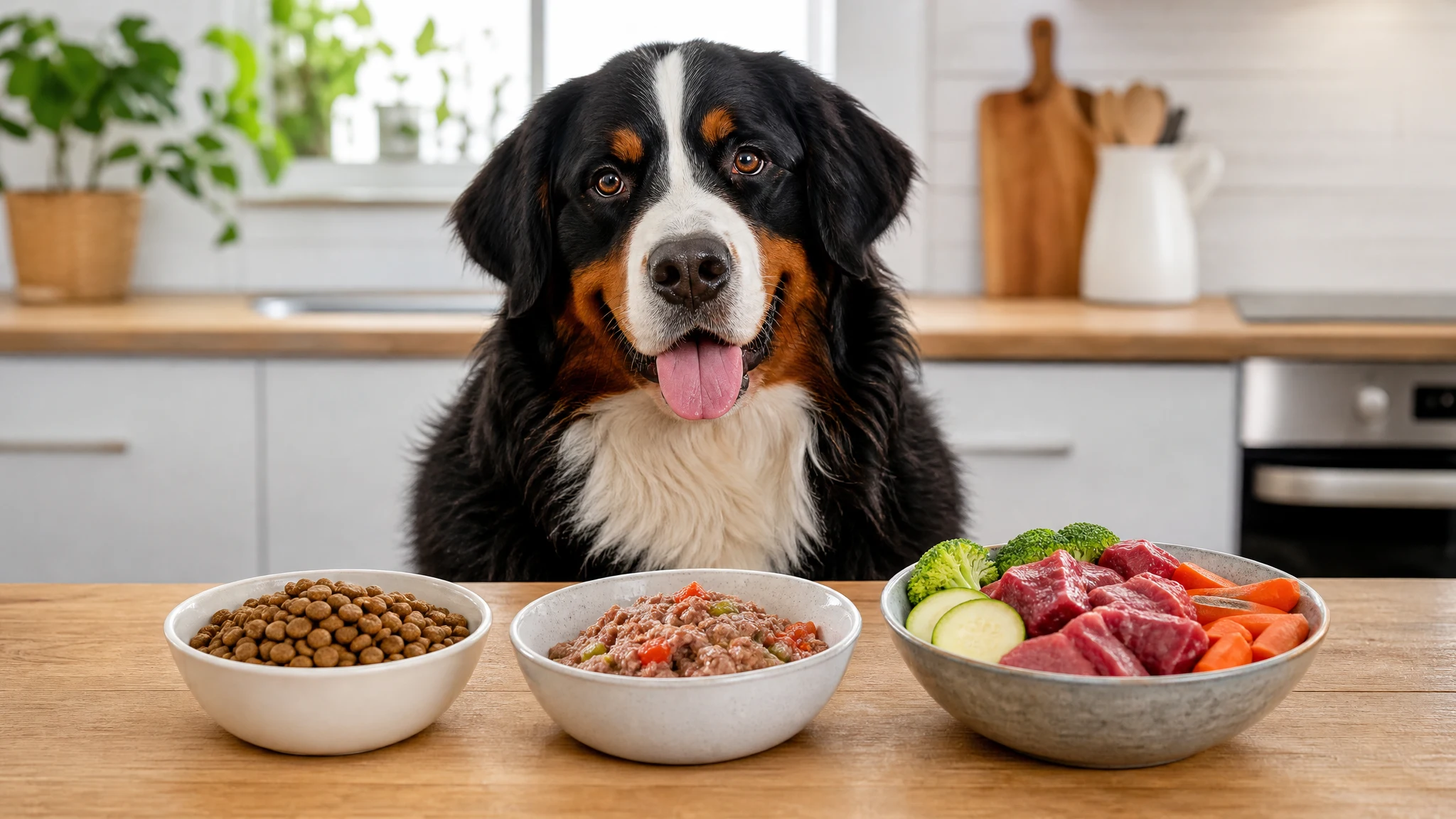
Wet, dry and fresh foods can all be complete and balanced for a large dog. The real differences are water content, calorie density, handling, and how easily each form fits a Bernese Mountain Dog's size and feeding routine.
This page looks at wet vs dry dog food and fresh dog food for Bernese Mountain Dogs, using label data from real products. If you want the full product-by-product view, see our foods compared guide.
How this comparison was done
We compared label data published by the brands. We did not run feeding trials or taste tests, and we have not fed any of these foods to dogs. Nothing here says one form is better for every Berner.
Products used as examples:
- Dry: Hill's Science Diet Adult Large Breed Chicken & Barley and Royal Canin Size Health Nutrition Large Adult.
- Wet: Hill's Science Diet Adult Chicken & Barley Entree in the 13 oz can.
- Fresh: Freshpet Large Dog Multi-Protein Recipe, plus the Freshpet puppy recipe for growth.
None of these is made specifically for Bernese Mountain Dogs. We found no Bernese-specific formula from these brands. The dry and fresh adult products are sized for large dogs. The wet entree is a general adult formula.
What matters for a Berner
PetMD lists the Bernese Mountain Dog as a large breed, with adults of roughly 70 to 115 pounds. Three points from PetMD shape the food choice.
- Deep-chested dogs, dogs fed from raised bowls and dogs fed once a day are at higher risk of bloat (gastric dilatation-volvulus). PetMD advises two meals about 12 hours apart, a slow feeder and no elevated bowls.
- For hip dysplasia, PetMD lists keeping a lean body among management steps. Calorie control matters.
- For puppies, PetMD advises AAFCO-compliant food designed for giant or large breeds, up to four meals a day.
These points do not say any food form prevents or treats a condition. A veterinarian decides what suits an individual dog.
Side-by-side comparison table
| Attribute | Dry | Wet (canned) | Fresh |
|---|---|---|---|
| Example product | Hill's Adult Large Breed; Royal Canin Large Adult | Hill's Adult Chicken & Barley Entree | Freshpet Large Dog Multi-Protein |
| Moisture signal on label | Water is not among the first five ingredients | Water is the first ingredient | Whole meats lead the list; no water listed first |
| Calories | 365 kcal per cup (Hill's); 360 kcal ME per cup (Royal Canin) | 369 kcal per 13 oz can | 348 kcal per cup (adult); 241 kcal per cup (puppy) |
| Large-breed formula | Yes, both examples | No, general adult | Adult is for large dogs; puppy statement covers large size dogs |
| Feeding guide on page | Chart by dog weight; Royal Canin offers a calculator | 1/2 can a day for a 5 lb dog up to 6 cans a day for a 120 lb dog | Cup amounts by weight; adult example given for 51 to 65 lb dogs |
| Kibble size | Not stated on the pages we used | Not applicable | Not applicable |
| Cost per day | Usually the lowest of the three, by general pattern | Climbs quickly for a large dog | Usually the highest, by general pattern |
Cost depends on the brand, the bag or can size and your dog's needs. We are not quoting prices. To compare fairly, divide the price by the number of calories in the package, then multiply by your dog's daily calories.
Moisture and what it does to the numbers
Wet food lists water first on the Hill's label. Fresh foods are also moist, though the Freshpet page we used does not put water at the top of its ingredient list. Dry food is the least moist of the three.
This changes how you read protein and fat. Hill's publishes dry matter averages, not minimums. Its wet entree shows 26.7 percent protein and 16.7 percent fat on a dry matter basis. Royal Canin Large Adult lists 24 percent minimum protein and 15 percent minimum fat, and Freshpet lists 20 percent minimum protein and 14 percent minimum fat. Those are different measurements, so do not rank the foods by these figures alone.
Ask each brand for dry matter values if you want a true comparison.
Calories per serving
The per-cup numbers are close for dry foods: 365 kcal per cup for Hill's Adult Large Breed and 360 kcal ME per cup for Royal Canin Large Adult. A 13 oz can of the Hill's wet entree has 369 kcal, so one can has about the same calories as one cup of the Hill's dry food.
The practical difference is volume. A can is one serving unit with the same calories as a cup of kibble, and Hill's feeding range reaches 6 cans a day for a 120 lb dog. That is a lot of cans to open, store and pay for.
Fresh adult food at 348 kcal per cup is similar per cup to the dry foods. The puppy recipe is lighter at 241 kcal per cup, so a growing dog needs more cups of it for the same energy. Freshpet's adult example covers dogs of 51 to 65 lb, which is below the usual Bernese adult range. Use the brand's own chart for your dog's weight.
All feeding charts are starting points. Hill's says to adjust amounts to maintain optimal weight and to ask your veterinarian if unsure. For a breed where PetMD stresses staying lean, weigh your dog regularly and adjust.
Dry food
Pros
- Large-breed adult and puppy formulas are easy to find from several brands.
- Calorie density is clear and consistent per cup.
- Storage is simple and the food keeps well once the bag is closed.
- Daily cost is generally lower for a dog that eats as much as a Berner.
Cons
- Lowest moisture of the three forms.
- Easy to over-scoop. A level cup measured with a proper cup matters.
- Kibble size is not stated on the pages we used. If your dog has a small or unusual mouth, check with the brand.
Wet food
Pros
- Water is the first ingredient on the Hill's entree label, so it adds moisture to meals.
- Easy to use as a topper over dry food.
- Needs no chewing of hard pieces.
Cons
- The Hill's entree is a general adult formula, not a large-breed one.
- Its page says it is not for puppies or mature adults.
- Feeding it alone to a large dog takes many cans a day, which makes cost and storage heavy.
People who search for wet food for Bernese Mountain Dogs usually want a topper or a meal for a picky eater. In that role, a few spoonfuls on kibble can work, if you count the calories.
Fresh food
Pros
- Whole meats lead the Freshpet ingredient lists, with chicken, egg, beef and salmon in the adult recipe.
- The puppy recipe carries the AAFCO statement for growth including growth of large size dogs (70 lbs or more as an adult), the wording a Berner puppy needs.
- Fresh dog food for Bernese Mountain Dogs can be served as one meal or split into two, per the brand.
Cons
- Usually the most expensive way to feed a dog this size.
- Needs refrigerator space, and a big dog needs a lot of it.
- The pages we used do not say whether the Freshpet recipes are grain free, so check the brand if that matters.
- Splitting servings into two meals is the safer pattern for a Berner, given PetMD's bloat advice.
Dental myths
You will hear that dry food cleans teeth and wet food rots them. The sources we used do not settle that. Neither Hill's nor Royal Canin says on the pages we used that its kibble cleans teeth.
Do not pick a food form for dental reasons alone. Ask your veterinarian about your dog's teeth and what care they recommend.
Mixing forms
Mixing is common, and Hill's describes its wet entree as useful as a topper for large dogs. A few rules keep it sensible:
- Count the calories from every food. Reduce the dry portion when you add wet or fresh.
- Stay with foods that are complete and balanced for your dog's life stage.
- Keep the Berner puppy base food large-breed appropriate, then add small toppers only.
- Change foods gradually, and tell your veterinarian if there is stomach upset.
A note on grain-free and DCM
The FDA investigated a possible link between certain diets and canine dilated cardiomyopathy. Its latest update is dated 12/23/2022, and the agency says it does not plan more public updates until there is meaningful new scientific information. All the dry and wet examples above are marked grain inclusive. Talk to your veterinarian about heart health and diet.
Best for, by use case
- Everyday adult feeding on a budget: dry. The calorie math is simple and the daily cost is usually lowest.
- Picky adult: dry with a measured wet topper, with the dry portion reduced.
- Large-breed puppy: any form whose label says growth including growth of large-size dogs. Hill's Puppy Large Breed, Royal Canin Large Puppy and the Freshpet puppy recipe all fit large dogs by their pages. The Victor Hi-Pro Plus Large Breed Puppy page gives an all life stages statement, but the large size clause was not captured, so confirm it with Victor.
- Dog that needs weight control: any form, with measured portions and your veterinarian's guidance.
- Owner who wants whole-food ingredients and has fridge space: fresh.
- Senior: Hill's Adult 6+ Large Breed is a large-breed dry option at 352 kcal per cup. Ask your veterinarian before changing.
Verdict
For most Bernese Mountain Dogs, a large-breed dry food is the practical base. It has clear calorie counts, a lower daily cost and an easy routine, and it fits the two-meal schedule PetMD advises against bloat.
Wet food earns a place as a topper. A single can has about as many calories as a cup of the Hill's dry food, so it replaces food rather than adding to it. Fresh food is a reasonable choice for owners who accept the cost and the fridge space. Its puppy recipe states large-dog growth coverage.
No form is proven better for the breed by the sources we used. Pick an AAFCO-complete food for your dog's life stage, measure it, watch body condition, and let your veterinarian guide changes. For brand details we could not confirm, such as kibble size, check with the brand.
Sources
- PetMD, Bernese Mountain Dog breed page
- Whole Dog Journal, nutritional adequacy statements
- FDA, investigation into diets and canine dilated cardiomyopathy
- Hill's Science Diet Adult Large Breed
- Hill's Science Diet Adult Chicken & Barley Entree
- Royal Canin Size Health Nutrition Large Adult
- Freshpet Large Dog Multi-Protein Recipe
- Freshpet Multi-Protein Puppy Recipe
- Victor Hi-Pro Plus Large Breed Puppy