Saint Berner: Bernese Mountain Dog x Saint Bernard Mix Explained
General nutrition information compiled from product labels and published sources, not veterinary advice. Your veterinarian is the right person to choose a diet for your dog, especially one with a health condition.
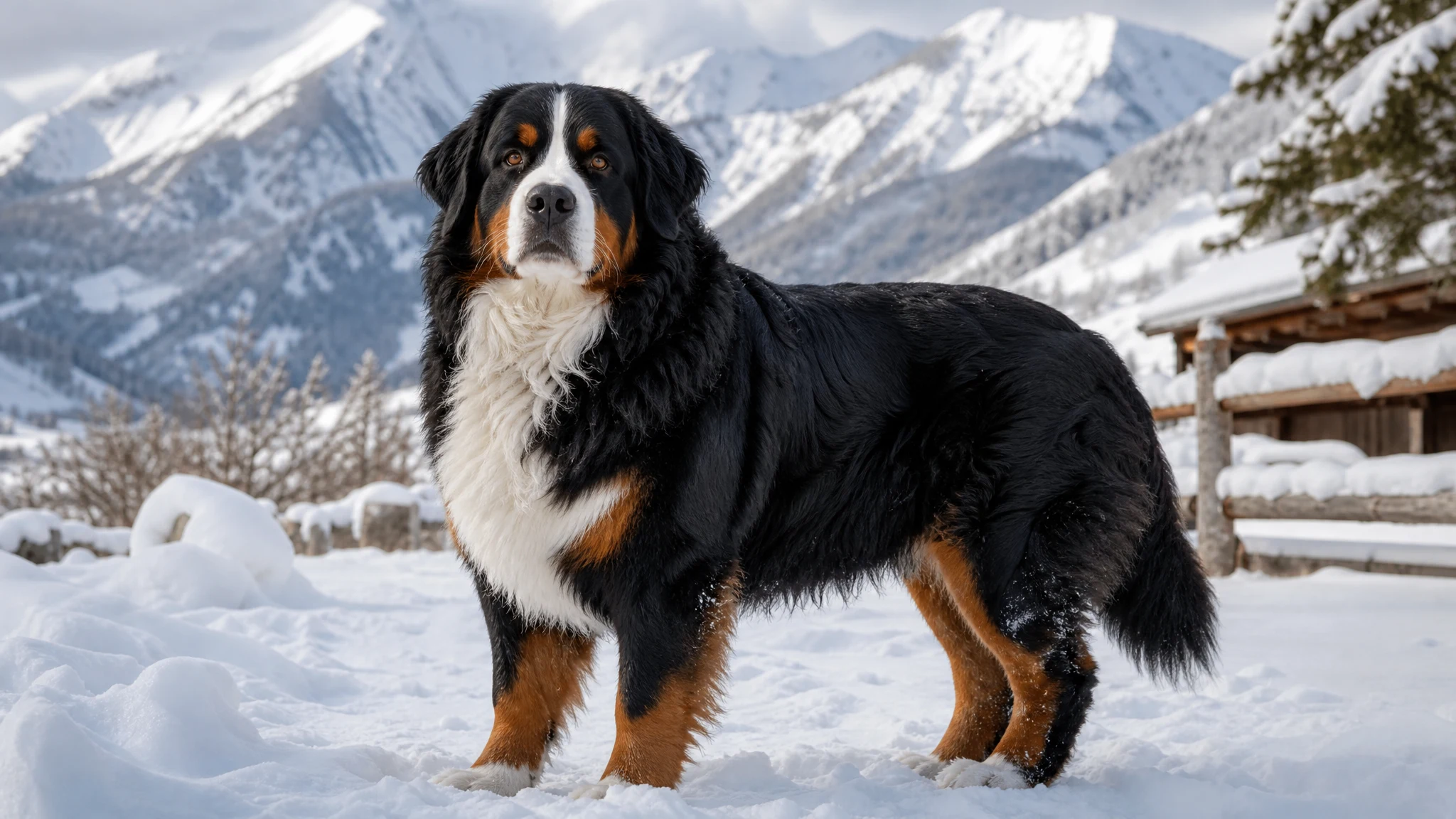
The St. Bernese Mountain Dog, more often called a Saint Berner, is a cross between a Bernese Mountain Dog and a Saint Bernard. It is not a recognized breed with its own standard, so no two litters are guaranteed to look or grow alike. That uncertainty matters most at the food bowl.
This guide walks through how to pick and portion food for a Saint Berner, step by step. It leans on what is documented for the Bernese side and on how pet food labels work. For anything about the Saint Bernard side or the mix itself, check with the breeder, a breed club and your veterinarian.
What we can and cannot say about this mix
PetMD lists the Bernese Mountain Dog as a large breed. PetMD gives an adult weight of 70 to 115 lb, while Wikipedia lists males at 80 to 120 lb and females at 75 to 100 lb. Those ranges are for purebred Bernese, not for the cross.
We did not find a published weight range or feeding standard for the Saint Berner, and we are not going to guess one. Ask the breeder for the weights of both parents, and ask your veterinarian to project your puppy's adult size.
One practical point follows from the Bernese side. Adults of that breed weigh 70 lb or more, so a Saint Berner is very likely to be a large dog. Large-dog label wording is therefore the safest starting place.
Materials you will need
- The breeder's information on both parents' size and health history
- A food label to read, from the bag, can or the brand's own website
- A standard measuring cup or a kitchen scale
- A slow-feeder bowl set at floor level
- A notebook or phone note to log weight, meals and stool quality
- A scheduled visit with your veterinarian
Step 1: Find out your dog's life stage and likely size
Puppies, adults and seniors need different foods. We did not find a published age at which a Bernese Mountain Dog counts as an adult, so ask your veterinarian when to switch from a growth food to an adult food for your dog.
Write down the current weight and the expected adult weight your vet gives you. You will use both numbers in the steps below.
Step 2: Read the AAFCO statement first
The nutritional adequacy statement tells you which dogs a food is designed for. Whole Dog Journal explains that foods for growth or for all life stages carry one of two kinds of wording. One says the food supports growth "including growth of large-size dogs (70 pounds or more as an adult)." The other says "except for growth of large-size dogs," which means it is not meant for large-breed puppies.
For a Saint Berner puppy, look for the "including" wording. PetMD also advises feeding Bernese puppies an AAFCO-compliant food designed for giant or large breeds, to support steady growth.
Be careful with a food that only says "all life stages." The large-size clause is what you need to see. For example, the Victor Hi-Pro Plus Large Breed Puppy page states the all life stages profile, but the large-size clause was not visible in what we reviewed, so confirm it on the bag or with Victor.
Step 3: Compare labels, not slogans
We compared label data published by the brands. We did not run feeding trials or taste tests, and we have not fed any of these foods to dogs. Treat the comparison below as a way to read labels, not as a ranking.
| Food (brand page) | Stage | Label notes |
|---|---|---|
| Hill's Science Diet Puppy Large Breed Chicken & Brown Rice | Puppy | 387 kcal per cup. Chicken is the first ingredient. Protein 26.7 and fat 15.4 are dry matter averages, not minimums. |
| Royal Canin Size Health Nutrition Large Puppy | Puppy | 349 kcal per cup. Minimum protein 28 percent, minimum fat 14 percent. The page describes adult weight of 56 to 100 lb. |
| Freshpet Multi-Protein Puppy Recipe | Puppy | Fresh food. The statement covers growth including large size dogs (70 lbs or more as an adult). About 241 kcal per cup. |
| Hill's Science Diet Adult Large Breed Chicken & Barley | Adult | 365 kcal per cup. Chicken first, then barley and rice. |
| Royal Canin Size Health Nutrition Large Adult | Adult | 360 kcal per cup. Minimum protein 24 percent, minimum fat 15 percent. Feeding table covers target adult weights of 57 to 97 lb. |
None of these is made for Bernese Mountain Dogs or for Saint Berners. We found no breed-specific formula, so each is a size-appropriate large-breed choice. Note that Hill's publishes dry matter averages while Royal Canin publishes guaranteed minimums, so the protein and fat numbers are not directly comparable.
The Royal Canin pages describe adult weights up to about 100 lb. If your Saint Berner is likely to grow past that, ask your veterinarian or the brand whether the feeding table still fits.
Step 4: Start from the label's feeding guide
Every brand's guide is a starting point. Hill's says to adjust amounts as necessary to maintain optimal weight, and to ask your veterinarian if you are unsure. As one example from Hill's Adult 6+ Large Breed page, the chart lists 3 cups for a 50 lb dog and 4 3/4 cups for a 100 lb dog. Another brand's chart will differ, because calories per cup differ.
For a broader walkthrough of portions by age and weight, see our Bernese Mountain Dog feeding chart. Use it as a reference, then confirm amounts with your vet for your individual dog.
Compare calories per cup before swapping foods. A switch from 349 to 387 kcal per cup, with the same cup count, changes daily calories noticeably.
Step 5: Set up meals to lower bloat risk
PetMD notes that deep-chested dogs, dogs fed from raised bowls and dogs fed once a day are at higher risk of gastric dilatation-volvulus, also called bloat. PetMD advises two meals about 12 hours apart, a slow feeder and no elevated bowls.
This is general breed guidance, not a promise about any one dog. Your Saint Berner may or may not be deep-chested, so ask your veterinarian how this applies. Puppies can be fed up to four meals a day, according to PetMD.
Step 6: Keep your dog lean and track results
For hip dysplasia, PetMD says management includes keeping a lean body, low-intensity exercise, omega-3s and joint supplements. Elbow dysplasia is also reported at high rates in Bernese, with studies cited on Wikipedia ranging from 13.91 percent to 26 percent. Food does not treat these conditions. Staying lean is one thing owners can control, and your veterinarian decides what is right for an individual dog.
Weigh your dog on a regular schedule and write it down. If weight climbs or drops without a reason, adjust the cups with your vet's input rather than guessing.
Do not add supplements on your own. Ask your veterinarian about any product and any amount.
Step 7: Change foods slowly
When you switch brands or stages, mix the new food in with the old over several days. Watch stool quality and appetite. If your dog has ongoing digestive upset, call your veterinarian rather than rotating through foods.
Tips
- Wet food can work as a topper. Hill's Adult Chicken & Barley Entree is a general adult formula, not a large-breed one, and its guide runs up to 6 cans a day for a 120 lb dog. If you add a topper, reduce the main meal so total calories stay steady.
- Read the whole ingredient list, not just the first line. Ingredient order alone does not tell you a food's quality.
- Ask the breeder about health testing in both parent breeds. The Bernese Mountain Dog Club of America health page is a good place to start on the Bernese side.
Common mistakes to avoid
- Feeding an "except for large-size dogs" puppy food. Check the statement wording every time you change bags.
- Treating the feeding chart as a rule. It is a starting point and needs adjusting.
- Feeding one big meal and using a raised bowl. Both are flagged by PetMD as bloat risk factors.
- Choosing food by fear headlines. The FDA's last update on its investigation into diets and canine dilated cardiomyopathy is dated 12/23/2022, and the agency says it does not plan further public updates until there is meaningful new scientific information. Ask your veterinarian what applies to your dog rather than relying on grain-free or marketing claims.
- Assuming the cross has Bernese traits. A Saint Berner may take after either parent. Plan around the dog in front of you.
What to expect
With a suitable large-breed food, measured portions and regular weigh-ins, many owners find it easier to keep a steady growth pattern and a lean body condition. Results vary, and no food can be promised to prevent or treat any health problem.
Lifespan is also uncertain. PetMD gives 7 to 10 years for Bernese, and the Bernese Mountain Dog Club of America says 7 to 8 years is too short, with some Berners reaching their teens. We found no source for the cross, so ask your vet what to plan for.
Sources
- PetMD, Bernese Mountain Dog breed page
- Bernese Mountain Dog Club of America, health
- Whole Dog Journal, nutritional adequacy statements
- FDA Center for Veterinary Medicine, diets and canine dilated cardiomyopathy
- Wikipedia, Bernese Mountain Dog
- Hill's Pet Nutrition product pages
- Royal Canin product pages
- Freshpet product pages
- Victor product pages