How Big Do Bernese Mountain Dogs Get? A Full-Grown Size and Weight Guide
General nutrition information compiled from product labels and published sources, not veterinary advice. Your veterinarian is the right person to choose a diet for your dog, especially one with a health condition.
If you are planning for a Bernese Mountain Dog puppy, the first practical question is usually how large the dog will be. The answer affects your car, your crate, your budget and your food choices.
This guide walks you through finding a realistic full grown Bernese Mountain Dog size, tracking your own dog's growth, and matching feeding to that growth. It is a method, not a prediction. No source can tell you the exact adult weight of one puppy.
What size is a full grown Bernese Mountain Dog?
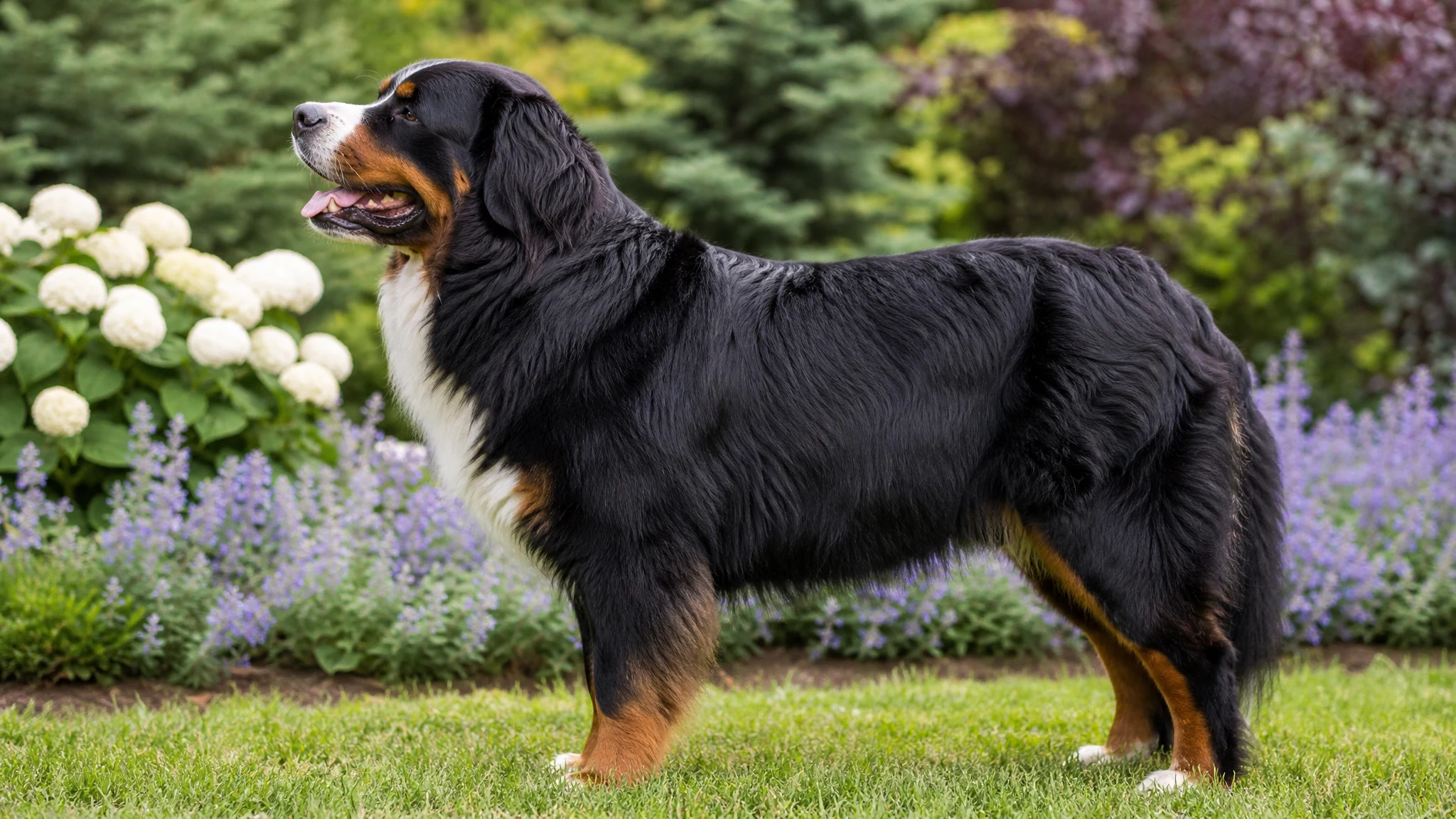
PetMD classifies the Bernese Mountain Dog as a large breed and lists an adult weight of 70 to 115 pounds. Wikipedia gives slightly different figures: males at 80 to 120 pounds and females at 75 to 100 pounds.
The two sources do not match exactly, which is normal for a breed with natural variation. Treat any range as a rough frame. A healthy dog can sit toward either end.
The AKC breed page would be the standard reference for height and weight, but it was not available to us when we checked. For an official breed standard, look at the AKC and the Bernese Mountain Dog Club of America (BMDCA) directly.
| Source | Adult weight given |
|---|---|
| PetMD breed page | 70 to 115 lb |
| Wikipedia (secondary source) | Males 80 to 120 lb; females 75 to 100 lb |
What you need
- A home scale or access to a vet clinic scale
- A notebook or phone note for dated weights
- The weights and sizes of your puppy's parents, if the breeder shares them
- The full feeding information from your puppy food's label
- A slow feeder bowl, a standard floor-level bowl and a measuring cup
- A relationship with a veterinarian who can check body condition
Step 1: Start with the parents
Ask the breeder for the weights of the sire and dam, and for any other relatives they know. Size runs in families, so this is more useful than a breed average.
Ask for actual numbers, not descriptions like "big." If the breeder does not know, write that down. It tells you your estimate will be looser.
Step 2: Use the breed range as a frame, not a target
Put the PetMD and Wikipedia ranges next to the parents' weights. If both parents sat near 90 pounds, a puppy ending up near 70 or 120 would be less typical, though not impossible.
Males tend to be heavier than females according to the Wikipedia figures. Keep that in mind when you set expectations.
Step 3: Weigh your puppy on a schedule
Weigh at the same time of day, ideally before a meal, and record the date. A weekly weigh-in works for most households. A vet visit can add a professional reading.
Plot the numbers over time. You are looking for a steady upward line, not sudden jumps. PetMD advises feeding puppies of this breed a food made for large or giant breeds to support steady growth, and it mentions up to four meals a day for puppies.
Step 4: Find out when growth is considered finished
We could not find a firm age at which a Bernese Mountain Dog counts as adult in the sources we used. Do not assume a specific month. Ask your veterinarian and your breeder when they expect your dog to finish growing, and when to move from puppy to adult food.
Large dogs often keep filling out after they reach adult height, but that is a question for your vet, who can see your dog.
Step 5: Pick a food with the right label wording
This is where size and nutrition meet. The Whole Dog Journal explains that foods for growth or all life stages carry one of two types of statement. One says the food covers growth "including growth of large-size dogs (70 pounds or more as an adult)." The other uses "except for" wording, which means the food is not meant for large-breed puppies.
Bernese adults reach 70 pounds or more, so for a puppy, look for the "including" wording. Read the full statement on the bag, not just the front.
We compared label data from the brands' own pages. We did not run feeding trials or taste tests, so this is a reading of labels, not a ranking of results. We also found no food made specifically for Bernese Mountain Dogs, so the examples below are large-breed puppy formulas.
- Freshpet Multi-Protein Puppy Recipe With Green Beans & Carrots states it is formulated for growth including growth of large size dogs (70 lbs or more as an adult). It lists 241 kcal per cup, calculated.
- Royal Canin Size Health Nutrition Large Puppy is a dry food listing 349 kcal ME per cup, as fed (calculated). Its page describes an adult weight of 56 to 100 pounds, which may fall short of a large male Bernese. Check with the brand about whether it suits your puppy.
- Hill's Science Diet Puppy Large Breed Chicken & Brown Rice lists 387 kcal per cup and a feeding-test statement for growing puppies. The portion we saw did not include the large-size clause, so confirm the full statement on the bag.
- Victor Hi-Pro Plus Large Breed Puppy lists 365 kcal per cup. Its all life stages statement was shown without the large-size clause, so again check the full label.
Calories per cup differ a lot between these foods, so the same cup does not mean the same energy. Always use the feeding guide for the exact food you buy, and treat it as a starting point. Hill's, for example, tells owners to adjust amounts to maintain optimal weight and to ask a veterinarian if unsure.
For more on how diet fits this breed over a lifetime, see Bernese Mountain Dog nutrition and the diet factors that matter.
Step 6: Set up feeding to lower bloat risk
Size matters for more than looks. PetMD notes that deep-chested dogs, dogs fed from raised bowls and dogs fed once a day have a higher risk of gastric dilatation-volvulus, often called bloat. It advises two meals about 12 hours apart, a slow feeder and no elevated bowls.
No food prevents bloat. These are habits that PetMD recommends, and your veterinarian can tell you what fits your dog.
Step 7: Check body condition, not only the number
A weight in the normal range does not mean your dog is lean. PetMD lists keeping a lean body as part of managing hip dysplasia in this breed. Ask your vet to show you how to feel for ribs and judge waist shape.
If your dog is heavier or lighter than expected, the vet decides whether to change the plan. Do not cut calories on your own for a growing puppy.
Tips
- Write down the brand's feeding guide, then adjust with your vet based on how your dog looks and feels.
- Count treats and toppers as part of the daily food. Hill's lists a 13 oz canned adult entree at 369 kcal per can, which is a lot of added energy for a topper.
- Re-check the label whenever you switch foods. Formulas and statements can change.
- Keep exercise low-intensity and steady, as PetMD suggests for dogs with joint concerns, and ask your vet what is right for a growing puppy.
Common mistakes to avoid
- Using one number as a promise. Ranges differ between sources. Your dog may land outside them.
- Choosing an adult or general puppy food. A statement with "except for growth of large-size dogs" is not meant for a Bernese puppy.
- Trying to speed growth. Larger sooner is not a goal. PetMD stresses steady growth.
- Using raised bowls or a single daily meal. PetMD links both to higher bloat risk.
- Judging by weight alone. Body condition tells you more.
What to expect
If you follow these steps, you may end up with a clear, dated growth record and a realistic idea of where your dog is heading. That can help you and your veterinarian spot changes early.
Many Bernese Mountain Dogs fall within the published ranges, but individual dogs vary. A steady weight line and a lean body shape are reasonable things to aim for. Neither is guaranteed.
Lifespan is also worth knowing when you plan long term. PetMD gives 7 to 10 years, while the BMDCA says 7 to 8 years is too short and that some Berners reach their teens. PetMD also notes the breed is prone to several cancers, notably histiocytic sarcoma. Diet does not prevent these. Regular vet visits are the place to discuss them.
Sources
- PetMD, Bernese Mountain Dog breed page
- Bernese Mountain Dog Club of America, health page
- Whole Dog Journal, nutritional adequacy statements
- Wikipedia, Bernese Mountain Dog
- Hill's Pet, Science Diet Puppy Large Breed
- Royal Canin, Size Health Nutrition Large Puppy
- Victor, Hi-Pro Plus Large Breed Puppy
- Freshpet, Multi-Protein Puppy Recipe With Green Beans & Carrots