Bernese Mountain Dog Puppies: Growth Stages and What to Expect
General nutrition information compiled from product labels and published sources, not veterinary advice. Your veterinarian is the right person to choose a diet for your dog, especially one with a health condition.
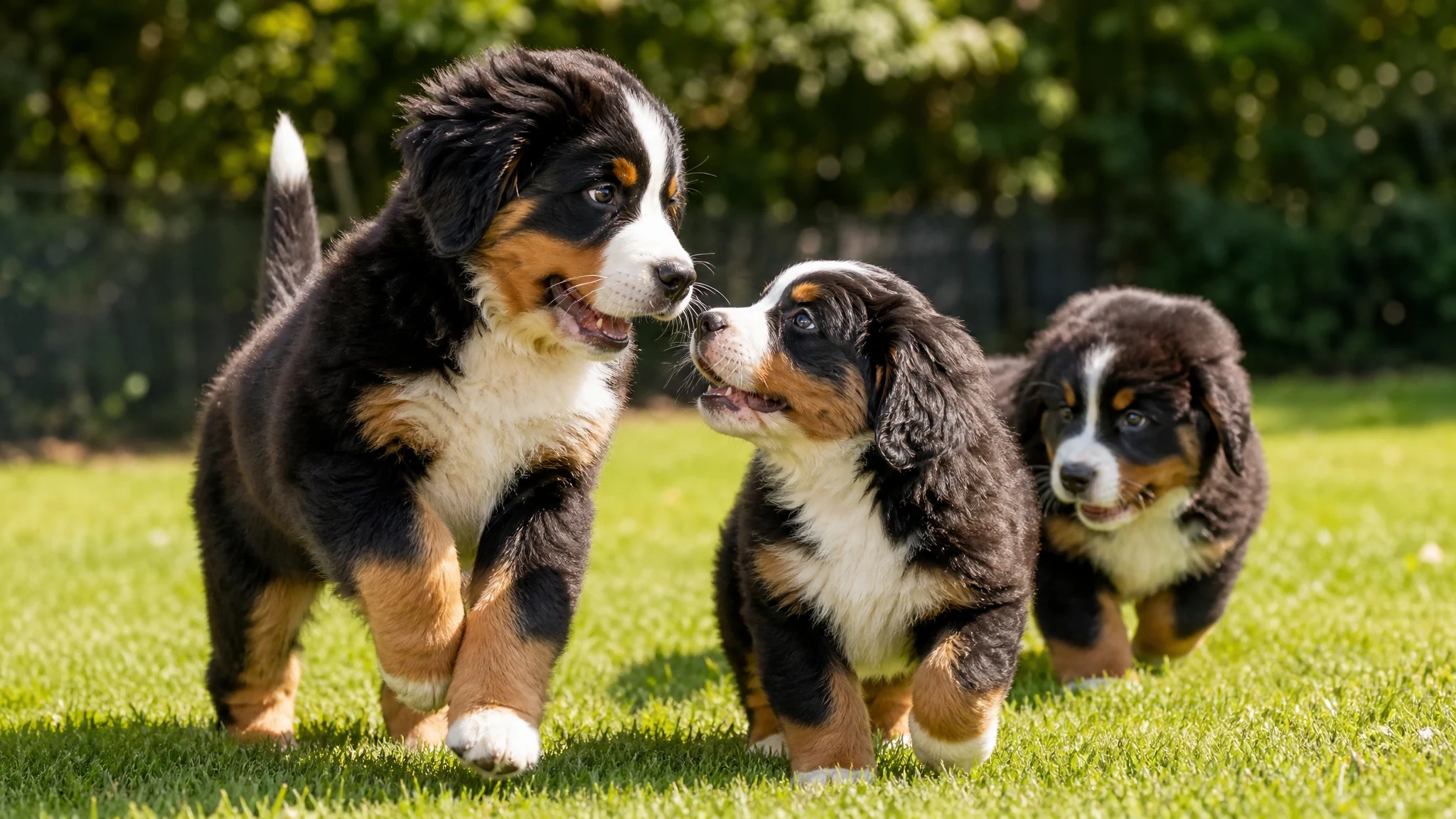
Bernese Mountain Dog puppies grow into large dogs. PetMD lists adults at roughly 70 to 115 pounds. That size shapes how you feed, exercise and plan for the first two years.
This guide walks through the growth stages as a set of steps. Each step covers what to do, what to watch, and which mistakes to avoid. We compared published label data and breed sources. We did not run feeding trials or taste tests, and nothing here replaces your veterinarian's advice for your own puppy.
What You Need Before You Start
- A puppy food whose label says it covers growth of large-size dogs (70 pounds or more as an adult).
- A kitchen scale or standard measuring cup, so portions are consistent.
- A slow-feeder bowl set at floor level.
- A notebook or phone note for weights, meals and questions for your vet.
- A veterinarian you can check in with as your puppy grows.
- Small, soft rewards for reward-based training. Use part of the daily food allowance when you can.
Step 1: Understand the Size You Are Planning For
PetMD classes the Bernese Mountain Dog as a large breed and lists adults at 70 to 115 pounds. Wikipedia lists males at 80 to 120 pounds and females at 75 to 100 pounds. The sources differ a little, so treat any adult weight as a range.
The sources we relied on do not give a firm age at which a Berner counts as fully grown. Ask your veterinarian or the Bernese Mountain Dog Club of America (BMDCA) how your puppy is tracking, rather than relying on a calendar date.
Lifespan also varies by source. PetMD gives 7 to 10 years. The BMDCA health page says that 7 to 8 years is too short a figure and that some Berners reach their teens. Good habits in puppyhood matter, but no one can promise a specific outcome.
Step 2: Choose a Puppy Food Labeled for Large Breeds
PetMD advises feeding puppies an AAFCO-compliant food designed for giant or large breeds, to support steady growth. The label is where you check this.
Whole Dog Journal explains the key wording. A food for growth or all life stages carries one of two statements. One says it covers growth "including growth of large-size dogs (70 pounds or more as an adult)." The other says "except for growth of large-size dogs," and that food is not meant for large-breed puppies. Because Bernese adults weigh 70 pounds or more, look for the "including" wording.
We found no formula made specifically for Bernese Mountain Dogs. The foods below are large-breed formulas, and the details come from each brand's own page. Check the brand for current labels, because formulas change.
| Food | Label statement | Calories | First ingredients listed |
|---|---|---|---|
| Freshpet Multi-Protein Puppy Recipe (fresh) | Growth including large size dogs (70 lbs or more as an adult) | 241 kcal per cup | Chicken, eggs, beef, beef liver, green beans |
| Royal Canin Size Health Nutrition Large Puppy (dry) | AAFCO growth profile, including large-size dogs; for puppies up to 15 months with adult weight of 56 to 100 lb | 349 kcal per cup | Chicken by-product meal, corn, wheat, chicken fat, wheat gluten |
| Hill's Science Diet Puppy Large Breed Chicken & Brown Rice (dry) | AAFCO feeding tests for growing puppies | 387 kcal per cup | Chicken, brown rice, whole grain oats, chicken meal, cracked pearled barley |
| Victor Hi-Pro Plus Large Breed Puppy (dry) | AAFCO All Life Stages; the large-size clause should be confirmed on the bag | 365 kcal per cup | Chicken, chicken meal, brown rice, whole grain millet, whole grain sorghum |
Two cautions on this table. Royal Canin's puppy page gives an adult weight range of 56 to 100 pounds, and Berners can run above that, so ask your vet whether the range suits your dog. For the Victor food, confirm the full AAFCO wording on the bag before assuming it covers large-breed growth.
Brand pages: Freshpet, Royal Canin, Hill's and Victor.
Step 3: Set Up Meals That Respect Bloat Risk
PetMD notes that deep-chested dogs, dogs fed from raised bowls and dogs fed once a day are at higher risk of gastric dilatation-volvulus, commonly called bloat. Its advice is two meals about 12 hours apart, a slow feeder and no elevated bowls.
For young puppies, PetMD says up to four meals a day can support steady growth. Your vet can tell you when to step down to two meals as your puppy matures.
Ask your veterinarian about bloat warning signs now, before you ever need them.
Step 4: Start With the Label Guide, Then Adjust
Feeding guides on the bag or brand page are starting points. Hill's puppy page, for example, says to adjust amounts as necessary to maintain optimal weight and to ask your veterinarian if you are unsure. Freshpet's puppy page says the food can be fed as one meal daily or divided into two, but PetMD's bloat advice suggests splitting meals, so talk to your vet about what fits a Berner puppy.
- Find your puppy's current weight at a vet visit or on a scale.
- Read the brand's feeding guide for that weight or age.
- Measure each meal, and count treats as part of the daily total.
- Check body condition every week or two. You should be able to feel the ribs under a light covering.
- Share your notes with your vet and change portions only with their guidance.
For a broader look at portions, see our Bernese Mountain Dog feeding chart.
Step 5: Keep Your Puppy Lean and Active at a Gentle Pace
PetMD lists a lean body and low-intensity exercise among the ways hip dysplasia is managed in the breed. It also mentions omega-3s and joint supplements. Whether any supplement suits your puppy is a veterinarian's decision, so do not add one on your own.
In practice, that means short walks, play on soft ground and no forced running or long jumping while the puppy is growing. Ask your vet what level of activity suits each month.
Step 6: Build Habits With Reward-Based Training
A Berner puppy will be a big dog before you know it, so manners matter early. Use rewards for sitting, walking beside you and greeting people calmly. This matches the approach recommended by the American Veterinary Society of Animal Behavior (AVSAB). Avoid shock, prong or choke collars, and avoid dominance methods.
Using part of the daily kibble as rewards keeps treats from adding extra calories.
Step 7: Plan for the Switch to Adult Food
Adult large-breed foods carry a maintenance statement instead of a growth statement. Examples include Royal Canin Large Adult and Hill's Adult Large Breed. Ask your vet when your puppy is ready to move over. Make the change gradually, mixing the new food in over several days, and watch stools and appetite.
Berners are also prone to several cancers, notably histiocytic sarcoma, according to PetMD. No food is known to prevent that, so regular vet visits matter more than any label.
Tips and Common Mistakes
- Feeding an adult or "except for large-size dogs" food to a puppy. Check the statement on the label.
- Free-feeding. Measured meals make it easier to see how much your puppy actually eats.
- Using a raised bowl. PetMD advises against elevated bowls.
- Chasing a fast growth rate. PetMD stresses steady growth, not speed.
- Judging a food by its front label. Read the AAFCO statement, ingredient list and calories per cup.
- Treating a grain-free label as a health claim. The FDA has investigated a possible link between certain diets and canine dilated cardiomyopathy. Its latest update is dated December 23, 2022, and it does not plan further public updates until there is meaningful new scientific information. Ask your vet about your puppy's diet.
What You Can Reasonably Expect
If you choose a labeled large-breed puppy food, measure meals and keep your puppy lean, you may see steady weight gain and consistent energy. Appetite and growth vary between puppies, so your vet's weight checks are the best guide.
Nothing here can promise a particular size, lifespan or health outcome. It simply sets up sound habits for the first stretch of life.