Mini Bernese Mountain Dog Mixes: Size, Temperament and Feeding
General nutrition information compiled from product labels and published sources, not veterinary advice. Your veterinarian is the right person to choose a diet for your dog, especially one with a health condition.
People often search for a bernese mountain dog mini, hoping for the look of a Berner in a smaller body. Here is the first thing to know: the sources we relied on describe the Bernese Mountain Dog as a large breed, and none of them describe a recognized miniature version. Smaller dogs sold under this name are usually mixes, and each litter can turn out differently.
This guide walks you through how to work out what size and temperament to plan for, then how to set up a feeding routine. It is a method, not a promise about any one dog.
What You Need Before You Start
- The names of both parent breeds, or a written statement from the breeder or rescue if the parentage is unknown.
- The adult weights of both parents, if the breeder can share them.
- A kitchen scale or a vet's scale for regular weigh-ins.
- A standard measuring cup (not a coffee mug or scoop).
- A slow-feeder bowl set at floor level.
- The label of the food you are considering, including the nutritional adequacy statement.
- Your veterinarian's phone number, for questions about your individual dog.
Step 1: Understand the Starting Point
PetMD lists the Bernese Mountain Dog as a large breed, with adults at roughly 70 to 115 lb. Wikipedia lists males at 80 to 120 lb and females at 75 to 100 lb. Sources differ a little, which is normal.
A mix is not a smaller copy of that dog. Size comes from both parents, and puppies in one litter can land at different adult weights. We did not find a published, reliable size range for Bernese mixes, so we will not guess one. Ask the breeder or rescue what the parents weigh and ask your vet to estimate from there.
Step 2: Estimate Adult Size Honestly
- Ask for parent weights. If both parents are available, their sizes are the best clue you can get.
- Treat any promise with caution. A seller who states an exact adult weight for a puppy is making a guess. Ask how they arrived at it.
- Plan for the larger outcome. If your mix could end up near 70 lb or more, feed as if it may be a large-breed dog until your vet says otherwise.
- Track growth. Weigh the puppy on a regular schedule and share the numbers at vet visits.
This matters for food. According to the Whole Dog Journal, a puppy food labeled for growth should say it covers "growth of large-size dogs (70 pounds or more as an adult)". A label that says "except for" that wording is not meant for large-breed puppies. If your puppy's adult size is uncertain, choose the "including" wording and ask your vet.
Step 3: Think Through Temperament
We found no published temperament data for Bernese mixes, so we cannot say how a given mix will behave. What you can do is look at the whole picture:
- Meet both parents when possible, and notice how they act around strangers and other dogs.
- Ask the breeder or rescue how the litter has behaved so far.
- Remember that the other parent breed matters as much as the Berner side.
Whatever the mix, use humane, reward-based training, in line with the American Veterinary Society of Animal Behavior (AVSAB). Treats, praise and play teach a dog what to do. Harsh corrections can make behavior problems worse.
Step 4: Choose a Food That Matches the Life Stage
We compared label data from the brands' own pages. We did not run feeding trials or taste tests, and we cannot say any food will suit your dog. No Bernese-specific formula turned up in our research, so the options below are large-breed or large-dog formulas. Check each brand's page for current labels.
Puppy options
- Hill's Science Diet Puppy Large Breed Chicken & Brown Rice: dry, 387 kcal per cup. Its first ingredients are chicken, brown rice, whole grain oats, chicken meal and cracked pearled barley.
- Royal Canin Size Health Nutrition Large Puppy: dry, for adult weights of 56 to 100 lb, 349 kcal per cup. Minimum protein is 28% and minimum fat is 14%.
- Victor Hi-Pro Plus Large Breed Puppy: dry, 365 kcal per cup, with 30% minimum protein. Its statement is for All Life Stages, and the page fragment we saw did not show the large-size clause, so confirm that wording with Victor.
- Freshpet Multi-Protein Puppy Recipe: fresh, 241 kcal per cup. Its statement covers growth including large-size dogs (70 lb or more as an adult).
Adult options
- Hill's Science Diet Adult Large Breed Chicken & Barley: dry, 365 kcal per cup.
- Royal Canin Size Health Nutrition Large Adult: dry, 360 kcal per cup, with 24% minimum protein and 15% minimum fat.
- Freshpet Large Dog Multi-Protein Recipe: fresh, 348 kcal per cup.
One caution on reading these numbers. Royal Canin and Victor list guaranteed minimums. Hill's publishes dry-matter averages, which are not guaranteed minimums, so do not compare those figures directly with another brand's.
Some owners ask about grain-free diets because of the heart disease question. The FDA's last update on its investigation into diets and canine dilated cardiomyopathy is dated December 23, 2022, and the agency said it does not plan more public updates until there is meaningful new science. Ask your vet what that means for your dog.
Step 5: Set Amounts and a Schedule
Start with the label's feeding guide, then adjust by body condition. Treat every amount as a starting point.
- Find your dog's weight. For a puppy, use the current weight, not the guessed adult weight.
- Read the brand's chart. For example, the Hill's Adult 6+ Large Breed chart shows 3 cups for a 50 lb dog and 4 3/4 cups for a 100 lb dog. Freshpet's Large Dog recipe suggests 2 1/2 to 3 cups a day for dogs of 51 to 65 lb. Royal Canin offers a feeding calculator on its product pages.
- Measure every meal with a standard measuring cup.
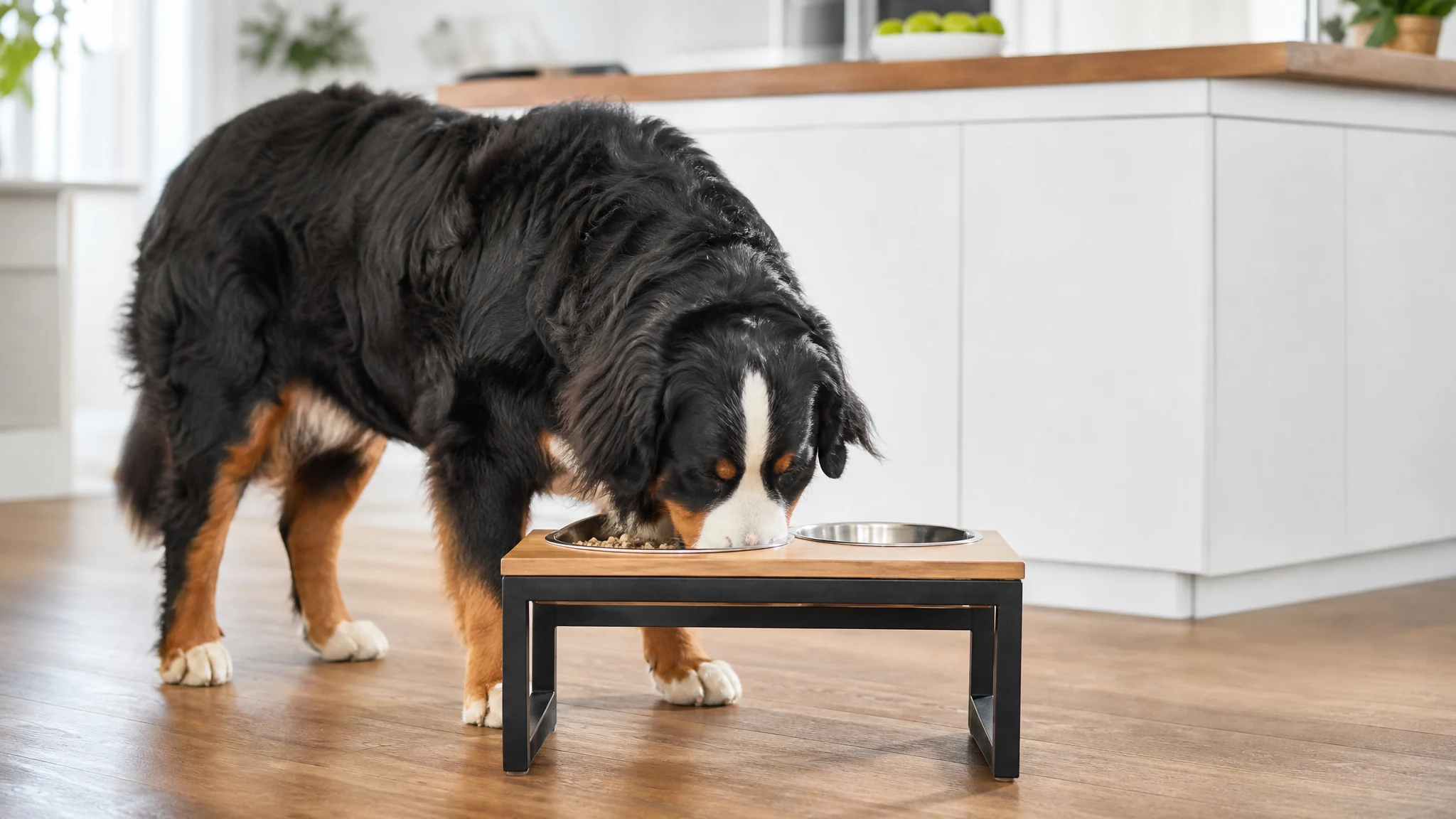
- Split the day into meals. PetMD advises two meals about 12 hours apart for Bernese Mountain Dogs and a slow feeder, with no raised bowls, because deep-chested dogs face a higher bloat risk. For puppies, PetMD suggests up to four meals a day.
- Adjust for activity. A very active dog may need more, and a quiet one less. Hill's notes to adjust amounts to maintain optimal weight.
- Recheck every few weeks. Weigh, feel the ribs, and change the portion in small steps.
For a longer walkthrough, see our Bernese Mountain Dog feeding chart guide.
If your dog has a health condition, confirm amounts with your veterinarian before you change anything. A veterinarian decides what is right for an individual dog, including any prescription diet.
Tips
- PetMD notes that a lean body is part of managing hip dysplasia. Keep your dog lean, and ask your vet about joint support rather than choosing a supplement on your own.
- PetMD says Berners are prone to several cancers, notably histiocytic sarcoma. No food has been shown to prevent that, so keep up with vet visits.
- Switch foods slowly, and ask your vet how to do it for your dog.
- Count treats and toppers as part of the daily amount.
Common Mistakes to Avoid
- Trusting the word "mini". It is a marketing label, not a size guarantee.
- Feeding adult food too early because the puppy looks small.
- Feeding once a day or using a raised bowl, which PetMD links to higher bloat risk.
- Using the cup size on the bag blindly. A chart is a starting point, not a verdict.
- Assuming a mix is healthier or calmer without evidence. We found none in our sources.
What to Expect
If you follow these steps, you may end up with a clearer picture of your dog's likely size and a feeding routine that supports steady growth and a healthy weight. Results vary by dog. Some mixes will stay well under Bernese size and others will not. Your vet's weigh-ins are the best guide.