Living With a Bernedoodle: Daily Care and Feeding
General nutrition information compiled from product labels and published sources, not veterinary advice. Your veterinarian is the right person to choose a diet for your dog, especially one with a health condition.
A Bernedoodle is a Bernese Mountain Dog and poodle mix. Because it is a crossbreed, no single rulebook covers every dog. Size, coat and health risks can lean toward either parent.
This guide gives a simple daily routine. It borrows from what PetMD says about the Bernese Mountain Dog, since the Bernese side is the one with documented feeding concerns. Where a Bernedoodle-specific answer is missing, we say so and point you to the breeder or your veterinarian.
What You Need Before You Start
- A complete and balanced dog food that suits your dog's age and size (see Step 2).
- A standard measuring cup or a kitchen scale.
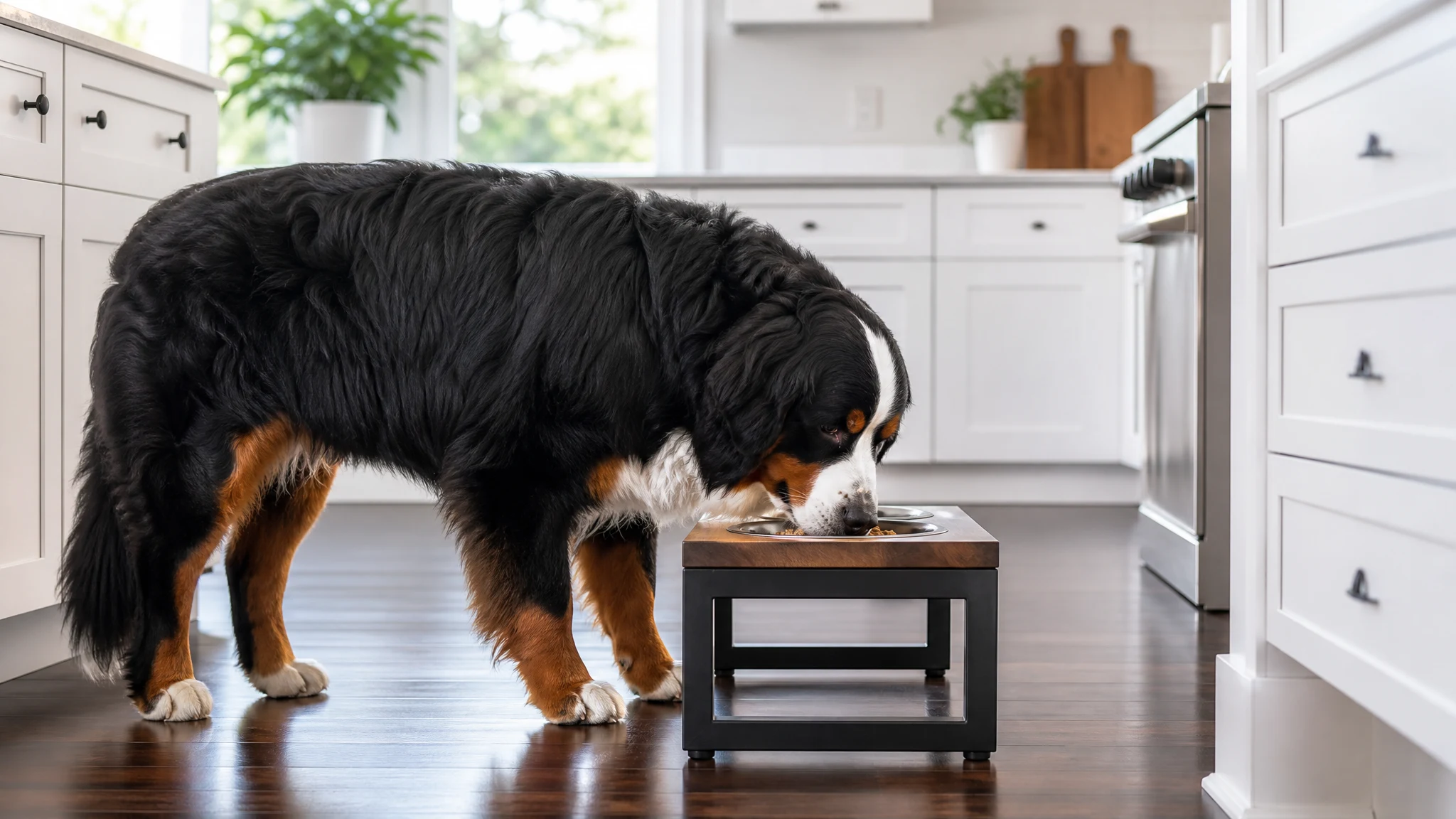
- A slow-feeder bowl that sits on the floor, not a raised stand.
- A notebook or phone note for meals, weight and body condition.
- A brush or comb suited to your dog's coat.
- The contact details for your breeder and your veterinarian.
Step 1: Find Out What Size Your Dog Will Be
Adult size changes what you feed. PetMD lists Bernese Mountain Dogs at roughly 70 to 115 lb. Poodle parents come in several sizes, so a Bernedoodle's adult weight can vary. We have no reliable figure for the cross, so ask the breeder for the parents' sizes and ask your veterinarian for a target weight.
This matters for puppies in particular. If the adult weight may reach 70 lb or more, shop for large-breed growth foods.
Step 2: Choose a Food by Reading the Label
We found no food made specifically for Bernedoodles, and none made specifically for Bernese Mountain Dogs. The practical choice is a large-breed or large-dog formula.
Start with the adequacy statement, the small print saying which life stage the food is built for. Whole Dog Journal explains the wording to look for on a puppy food: "including growth of large-size dogs (70 pounds or more as an adult)." A statement that says "except for growth of large-size dogs" means the food is not meant for large-breed puppies.
Adult dogs need a statement for maintenance or all life stages. Then look at the ingredient list, calories per cup and the feeding guide.
A Label Comparison of Large-Dog Foods
We compared label data published by each brand. We did not run feeding trials or taste tests, and we are not saying one food is better than another. Hill's lists dry-matter averages for protein and fat, so those numbers are not directly comparable with the as-fed minimums that Royal Canin and Victor list.
| Food | Stage | Calories per cup | Protein and fat |
|---|---|---|---|
| Hill's Science Diet Puppy Large Breed Chicken & Brown Rice | Puppy | 387 | 26.7% protein, 15.4% fat (dry matter averages) |
| Royal Canin Size Health Nutrition Large Puppy | Puppy | 349 | 28% protein min, 14% fat min |
| Hill's Science Diet Adult Large Breed Chicken & Barley | Adult | 365 | 23.8% protein, 15% fat (dry matter averages) |
| Royal Canin Size Health Nutrition Large Adult | Adult | 360 | 24% protein min, 15% fat min |
Victor's Hi-Pro Plus Large Breed Puppy carries an All Life Stages statement. The part of that statement about large-size dogs was not clear in the label text we saw, so confirm it with the brand before choosing it for a puppy.
Freshpet's Multi-Protein Puppy Recipe states it meets AAFCO profiles for growth, including growth of large-size dogs (70 lbs or more as an adult).
For more on the diet factors that matter in this family of dogs, see Bernese Mountain Dog nutrition and the diet factors that matter.
Step 3: Set the Starting Amount and Schedule
Use the feeding guide on your chosen food as a starting point. Match it to your dog's current weight, age and activity level, then adjust. Hill's advises adjusting amounts as necessary to maintain optimal weight and asking your veterinarian if you are unsure.
Some label examples show how much amounts differ between products:
- Hill's Science Diet Adult 6+ Large Breed: the chart lists 3 cups for a 50 lb dog and 4 3/4 cups for a 100 lb dog.
- Victor Senior Healthy Weight: add 1/2 cup for every 20 lb over 100 lb.
- Freshpet Large Dog Multi-Protein Recipe: 2 1/2 to 3 cups per day for dogs of 51 to 65 lb.
Those amounts come from different foods with different calories, so they cannot be swapped. Always use the chart on the bag or website of the food you actually buy.
For schedule, PetMD advises puppies get a large-breed growth food in up to four meals a day. For adult Bernese Mountain Dogs, it advises two meals about 12 hours apart.
Step 4: Feed in a Way That Respects Bloat Risk
Gastric dilatation-volvulus, or bloat, is a risk in deep-chested dogs. PetMD says dogs fed from raised bowls and dogs fed once a day are at higher risk. Its advice is two meals about 12 hours apart, a slow feeder and no elevated bowls.
Deep-chested is a Bernese trait, and a Bernedoodle may or may not share it. Following the cautious routine costs little either way.
Talk to your veterinarian about the signs of bloat and what to do. It is an emergency, and we can't tell you how to handle it at home.
Step 5: Track Weight and Body Condition
Weigh your dog every few weeks and note the result. Feel the ribs: you should be able to feel them under a light covering, without pressing hard. If you are unsure, ask your veterinarian to show you what to look for.
PetMD lists a lean body and low-intensity exercise as part of managing hip dysplasia in Bernese Mountain Dogs. Wikipedia reports elbow dysplasia studies in the breed ranging from 13.91% to 26%. Because the Bernedoodle shares half its ancestry with the Bernese, joint health is worth raising with your veterinarian. Food is only one piece of that picture, and no food has been shown to prevent these conditions.
Step 6: Build the Rest of the Daily Routine
- Morning: a calm walk, then breakfast. Keep activity gentle around mealtimes.
- Midday: a short outing, play or training session using treats and praise. Count treats toward the day's food.
- Evening: dinner about 12 hours after breakfast, then quiet time.
- Weekly: brush the coat thoroughly and check ears, paws and skin. Ask your groomer or breeder what coat type to expect, since curl and shedding vary.
Keep training reward-based, in line with the American Veterinary Society of Animal Behavior. Use treats, praise and play rather than force.
Tips and Common Mistakes
- Switching foods too fast. Mix the new food in with the old over several days. Ask your veterinarian for a schedule if your dog has a sensitive stomach.
- Using a puppy food that is not for large breeds. Check for the "including growth of large-size dogs" wording.
- Raised bowls and one big meal. Both are flagged by PetMD for bloat risk.
- Trusting marketing words. Terms like "premium" or "natural" are not nutrition data. The adequacy statement and ingredient list are.
- Adding supplements by guesswork. Joint products and omega-3s are mentioned by PetMD in hip dysplasia management, but ask your veterinarian whether your dog needs one and what amount is right.
- Ignoring the grain-free question. The FDA has investigated a possible link between certain diets and canine dilated cardiomyopathy. Its last update was dated 12/23/2022, and it said it did not plan further public updates without meaningful new science. Ask your veterinarian what this means for your dog.
Dogs With a Health Condition
Bernese Mountain Dogs are prone to several cancers, notably histiocytic sarcoma, according to PetMD. A Bernedoodle may carry some of that risk. If your dog has a diagnosed condition, confirm food type and amounts with your veterinarian before changing anything. Prescription diets are something only a veterinarian prescribes.
Lifespan figures vary by source. PetMD gives 7 to 10 years for the Bernese, and the Bernese Mountain Dog Club of America says 7 to 8 years is too short, with some reaching their teens. We have no lifespan figure for the cross.
What to Expect
With a steady schedule and a food matched to your dog's life stage, many owners find mealtimes become predictable and stools more consistent. A food that suits your dog may also help keep weight steady, though results differ from dog to dog.
Check in with your veterinarian at regular visits. They can confirm whether your dog's weight, growth and amounts are on track.
Sources
- PetMD, Bernese Mountain Dog breed page
- Bernese Mountain Dog Club of America, health page
- Whole Dog Journal, nutritional adequacy statements
- FDA Center for Veterinary Medicine, diets and canine dilated cardiomyopathy
- Wikipedia, Bernese Mountain Dog
- Hill's Pet Nutrition product pages
- Royal Canin product pages
- Victor product pages
- Freshpet product pages