German Shepherd Bernese Mountain Dog Mix: Temperament and Exercise Needs
General nutrition information compiled from product labels and published sources, not veterinary advice. Your veterinarian is the right person to choose a diet for your dog, especially one with a health condition.
A German Shepherd Bernese Mountain Dog mix is a crossbreed, so no breed standard tells you how one puppy will turn out. Size, energy and personality can lean toward either parent. This guide shows how to work out what your own dog needs, step by step, and how to match food and exercise to it.
The approach is simple. Gather what you can learn about the parents, watch the individual dog, build a routine, and check your plan with your veterinarian.
What you need before you start
- Any information from the breeder or rescue about both parents (size, health history, behavior).
- A notebook or phone notes to track weight, meals, walks and behavior.
- A flat buckle collar or a well-fitted harness, and a standard leash.
- Small, soft treats for reward-based training.
- A kitchen scale or a standard measuring cup for meals.
- A slow feeder bowl, set on the floor.
- A food made for large dogs, chosen by reading the label.
- A veterinarian you can ask about growth, weight and joints.
Step 1: Learn what you can about both parents
With a mixed-breed dog, the parents are your best clue. Ask how large each parent is, how active they are, and how they behave with strangers, children and other dogs. Ask about health problems in the family too.
For the Bernese side, the Bernese Mountain Dog Club of America publishes a health page that is a good starting point. PetMD's Bernese Mountain Dog breed page lists adult weight at 70 to 115 pounds and calls the breed large. For the German Shepherd side, check with a breed club or your veterinarian rather than relying on general descriptions.
Common mistake: assuming the mix will be an even blend. Puppies in one litter can differ a lot in size and energy.
Step 2: Observe the temperament of your individual dog
Temperament is easier to read in the dog in front of you than to predict from a breed label. Over the first few weeks, note how your dog reacts to new people, new sounds and unfamiliar places. Notice how quickly they settle after play, and whether they are happier with a job to do or happy to nap.
Write down what you see. Patterns in these notes will tell you more than any generalization about the cross.
- Does your dog recover quickly from a startle, or stay worried?
- Is your dog calm indoors after a walk, or restless?
- How does your dog behave around other dogs and children?
If you see fear, guarding or reactivity, talk to your veterinarian. They can rule out pain or illness and may refer you to a qualified behavior professional who uses reward-based methods.
Step 3: Train with rewards from day one
Large dogs are easier to live with when they learn good manners early. Use short sessions, small treats and praise. This matches the guidance of the American Veterinary Society of Animal Behavior (AVSAB), which supports reward-based training.
Teach sit, down, a relaxed loose-leash walk and a reliable recall in quiet places first. Add distractions slowly.
Common mistake: using harsh corrections. Shock, prong or choke collars, alpha rolls and scruffing can increase fear and stress. They are not part of humane training.
Step 4: Build an exercise routine and adjust it
No source we relied on gives a verified daily exercise time for this cross, so we will not invent one. Build the routine from your dog's age, body condition and joint health, and confirm it with your veterinarian.
- Start with steady, moderate activity. Daily walks, sniffing time and gentle play suit most large dogs.
- Add mental work. Training games, food puzzles and scent games can tire a dog in ways walking alone may not.
- Go easy on growing joints. Ask your veterinarian how much running, jumping and stair use is appropriate for a puppy of this size.
- Watch how your dog recovers. Stiffness, limping or reluctance to move after activity is a reason to call your veterinarian.
- Adjust with the seasons and the dog's age. Large dogs may need shorter, gentler outings as they get older.
Joint health matters for both parent breeds' size class. PetMD says management of hip dysplasia in Bernese Mountain Dogs includes keeping a lean body and low-intensity exercise. A mix may or may not share this risk, so ask your veterinarian whether screening makes sense for your dog.
Step 5: Feed for steady growth and a lean body
Food and exercise work together. Extra weight adds strain on joints, so many owners find that tracking body condition helps more than tracking cups alone.
Puppies
PetMD advises feeding puppies of large breeds an AAFCO-compliant food designed for giant or large breeds, in up to four meals a day, to support steady growth. On the label, look for wording such as "including growth of large-size dogs (70 pounds or more as an adult)." Wording that says "except for growth of large-size dogs" means the food is not suited to large-breed puppies, according to Whole Dog Journal's guide to nutritional adequacy statements.
If your mix could reach 70 pounds or more as an adult, choose the "including" wording. Your veterinarian can help you estimate adult size.
Adults
For adults, a large-breed maintenance food with an AAFCO adult maintenance statement is a reasonable starting point. For more detail on amounts by weight and age, see our Bernese Mountain Dog feeding chart.
How we compared foods
We compared label data published by each brand. We did not run feeding trials or taste tests, and nothing here says one food is better for your dog. The table below shows calories per cup for several large-breed formulas, as stated on the brand pages.
| Food | Life stage | Calories per cup (brand page) |
|---|---|---|
| Hill's Science Diet Puppy Large Breed Chicken & Brown Rice | Puppy | 387 kcal |
| Royal Canin Size Health Nutrition Large Puppy | Puppy | 349 kcal ME (calculated) |
| Hill's Science Diet Adult Large Breed Chicken & Barley | Adult | 365 kcal |
| Royal Canin Size Health Nutrition Large Adult | Adult | 360 kcal ME (calculated) |
| Hill's Science Diet Adult 6+ Large Breed | Senior | 352 kcal |
Brand pages are the place to confirm current ingredients and guaranteed analysis: Hill's puppy large breed, Royal Canin large adult and Royal Canin large puppy. Royal Canin lists its large puppy formula for adult weights of 56 to 100 pounds, so check that your dog fits that range.
Portions as a starting point
Label feeding guides are starting points, not rules. The Hill's Adult 6+ Large Breed page, for example, shows a chart example of 3 cups a day for a 50 pound dog and 4 3/4 cups for a 100 pound dog. Hill's advises adjusting amounts to maintain optimal weight and asking your veterinarian if you are unsure. Follow the chart on the exact food you buy, and adjust based on your dog's body condition.
If your dog has a health condition, confirm amounts and food choice with your veterinarian before changing anything.
Step 6: Reduce bloat risk around meals
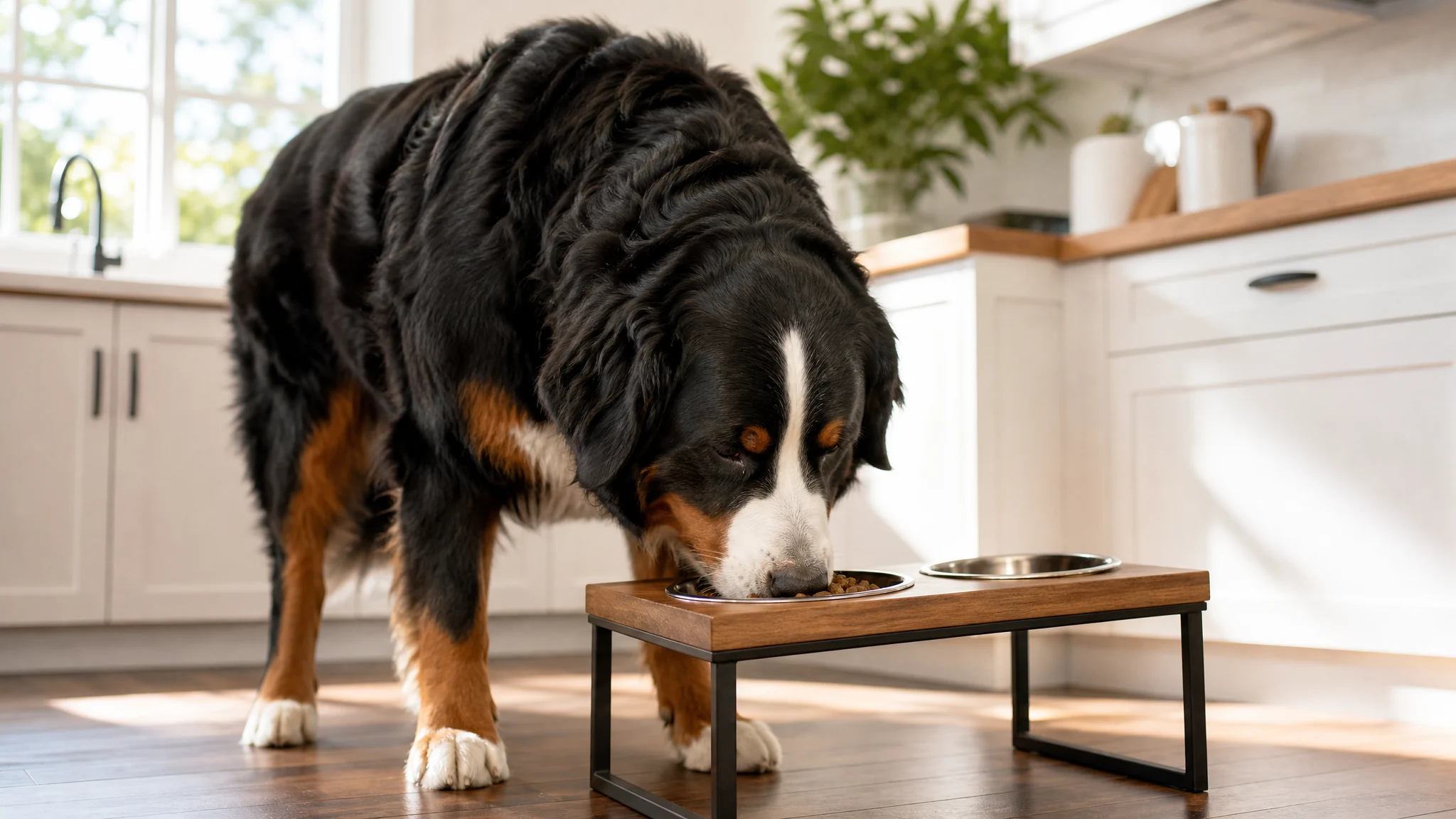
PetMD notes that deep-chested dogs, dogs fed from raised bowls and dogs fed once a day are at higher risk of gastric dilatation-volvulus, also called bloat. Its advice is two meals about 12 hours apart, a slow feeder and no elevated bowls.
Bloat is an emergency. A veterinarian decides how it affects an individual dog, so ask about your dog's risk at your first visit.
Tips for success
- Weigh your dog on a regular schedule and write down the number.
- Count treats as part of the daily food amount.
- Keep outings steady rather than saving all activity for weekends.
- Introduce any new food gradually, mixing it with the old one.
- Ask your veterinarian before adding any supplement. We do not give supplement amounts.
Common mistakes to avoid
- Over-exercising a puppy because the dog looks big and strong.
- Feeding a food labeled "except for growth of large-size dogs" to a large-breed puppy.
- Using an adult food chart for a growing puppy.
- Choosing a food by marketing claims instead of the label.
- Assuming grain-free or any ingredient trend is safer. The FDA's investigation into diets and canine dilated cardiomyopathy had its latest update on December 23, 2022, and the agency says it does not plan further public updates until there is meaningful new scientific information. Ask your veterinarian about heart health and diet.
What results to expect
With consistent routines, many owners find their dog settles more easily, behaves better on walks and keeps a steadier weight. Results vary by dog, and none are guaranteed.
Food does not prevent or treat disease. Only a veterinarian can say what your dog needs, especially for joints, weight or any health concern.
Lifespan is also hard to predict for a mix. PetMD gives 7 to 10 years for Bernese Mountain Dogs, while the Bernese Mountain Dog Club of America says 7 to 8 years is too short and that some reach their teens. Your dog's own history is the better guide.