Best Puppy Food for Bernese Mountain Dog Puppies
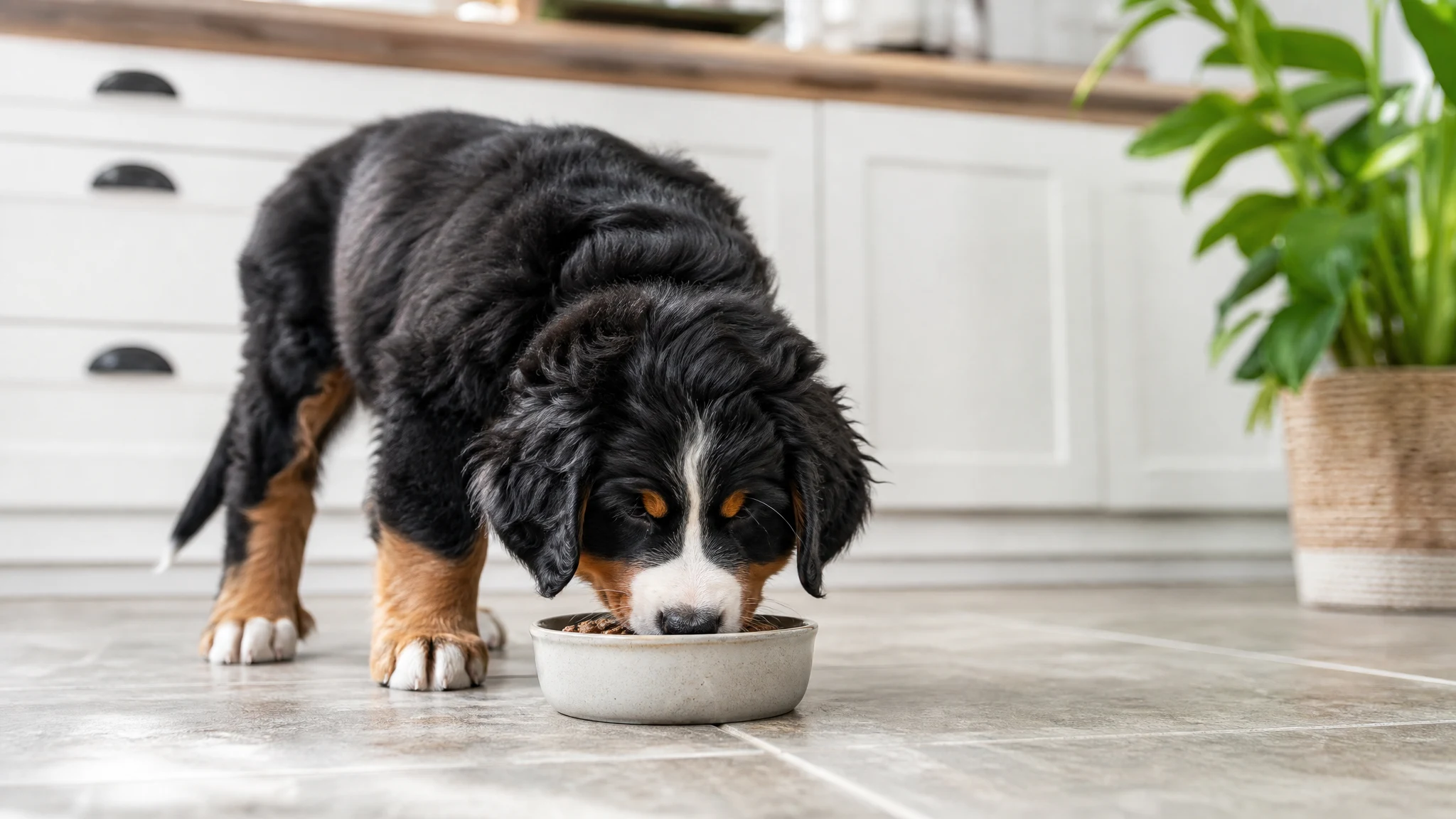
General nutrition information compiled from product labels and published sources, not veterinary advice. Your veterinarian is the right person to choose a diet for your dog, especially one with a health condition.
Choosing Bernese Mountain Dog puppy food is harder than it looks. The bags are covered in photos of mountains and happy dogs, but the useful facts are in small print on the back.
This guide shows how to read that print. It also compares four large-breed puppy foods using the label data their brands publish. No brand makes a Bernese-specific formula that we could find, so every pick here is a large-breed or large-dog puppy food.
One note on method. We compared label data. We did not run feeding trials or taste tests, and we are not ranking foods by how dogs like them.
Why Bernese puppies need a large-breed approach
PetMD lists the Bernese Mountain Dog as a large breed, with adults of about 70 to 115 pounds. Wikipedia gives somewhat different ranges: 80 to 120 pounds for males and 75 to 100 pounds for females. The sources differ slightly, but all of them put the adult weight well above 70 pounds.
That matters for puppy food. PetMD advises feeding puppies an AAFCO-compliant food designed for giant or large breeds, to support steady growth. It also advises feeding puppies up to four meals a day.
The practical takeaway is simple. Look for a puppy food labeled for large breeds, and then confirm it on the nutritional adequacy statement, covered next.
What to look for: the quality indicators that matter
1. The right AAFCO growth wording
This is the single most useful check. Whole Dog Journal explains that foods for growth or for all life stages carry one of two kinds of statement. One says the food is for growth "including growth of large-size dogs (70 pounds or more as an adult)." The other says "except for growth of large-size dogs."
The first kind is suitable for large-breed puppies. The second is not. Bernese adults weigh 70 pounds or more, so look for the "including" wording on any food you consider.
Whole Dog Journal is a secondary source here. The same "including growth of large size dogs" wording appears on the Freshpet puppy product page, which is the brand's own label data.
2. A named animal protein first
Ingredients are listed by weight before cooking, so the first few matter most. Every food compared below lists a named animal source (chicken, a chicken meal, or chicken by-product meal) first. Whether you are comfortable with a by-product meal or a whole-meat first ingredient is a judgment call. Read the list and decide what you prefer.
3. Calories per cup
Calorie density tells you how far a cup goes and how fast a puppy gets energy. The picks below range from 241 to 387 kilocalories per cup. A fresh food and a dry food can differ a lot in how much you serve, even when they look similar on the shelf.
4. Clear guaranteed analysis, and the basis it uses
Protein, fat and fiber numbers are only comparable if they are measured the same way. Some brands publish guaranteed minimums as fed. Hill's publishes dry matter averages instead, which are not guaranteed minimums. Never line the two up as if they were the same kind of number.
5. A feeding guide you can use as a starting point
A feeding chart is a starting point, not a prescription. Hill's says to adjust amounts as necessary to maintain optimal weight and to ask your veterinarian if you are unsure. That is good advice for any brand.
Key features to compare
The table below uses only data published on each brand's own product page. Where a brand did not state something, it says so.
| Food | Form | First ingredients | Calories | Growth statement |
|---|---|---|---|---|
| Hill's Science Diet Puppy Large Breed Chicken & Brown Rice | Dry | Chicken, brown rice, whole grain oats, chicken meal, cracked pearled barley | 387 kcal per cup | Feeding tests substantiate complete and balanced nutrition for growing puppies |
| Royal Canin Size Health Nutrition Large Puppy | Dry | Chicken by-product meal, corn, wheat, chicken fat, wheat gluten | 349 kcal ME per cup (calculated) | Meets AAFCO profiles for growth, including growth of large-size dogs |
| Victor Hi-Pro Plus Large Breed Puppy | Dry | Chicken, chicken meal, brown rice, whole grain millet, whole grain sorghum | 365 kcal per cup | AAFCO profiles for all life stages |
| Freshpet Multi-Protein Puppy Recipe With Green Beans & Carrots | Fresh | Chicken, eggs, beef, beef liver, green beans | 241 kcal per cup (calculated ME) | Growth, including growth of large size dogs (70 lbs or more as an adult) |
Kibble size was not stated on the product pages for the three dry foods, so check the brand if size matters for your puppy.
Top picks by food type
You may expect picks sorted by price. We did not include prices, because they change and vary by store, and we will not guess at them. Check the brand's page or your local store for current cost. The picks below are grouped by the type of food instead.
Hill's Science Diet Puppy Large Breed Chicken & Brown Rice Recipe (dry)
This is a dry food made for large-breed puppies. Its first five ingredients are chicken, brown rice, whole grain oats, chicken meal and cracked pearled barley. It is not grain-free, and it provides 387 kilocalories per cup, the highest of the four.
Hill's publishes dry matter averages: about 26.7 percent protein, 15.4 percent fat and 2.8 percent crude fiber. Those are averages, not guaranteed minimums.
The statement we found says animal feeding tests using AAFCO procedures substantiate complete and balanced nutrition for growing puppies. The page fragments we found did not show the large-size-dogs clause. Look for it on the bag, or ask the brand. Details are on the Hill's product page.
Royal Canin Size Health Nutrition Large Puppy (dry)
Royal Canin describes this food for puppies up to 15 months old whose adult weight will be 56 to 100 pounds. Be aware that the Bernese range from PetMD runs higher, up to 115 pounds, so a large Bernese may finish above that band. Ask your veterinarian whether it suits your puppy.
The brand lists guaranteed minimums of 28 percent protein and 14 percent fat, and a maximum of 3.7 percent fiber. The first five ingredients are chicken by-product meal, corn, wheat, chicken fat and wheat gluten. It is not grain-free, and it states AAFCO growth nutrition that includes large-size dogs.
The page offers a feeding calculator. See the Royal Canin product page.
Victor Hi-Pro Plus Large Breed Puppy (dry)
Victor lists 30 percent minimum protein, 14 percent minimum fat and 6 percent maximum fiber. The first five ingredients are chicken, chicken meal, brown rice, whole grain millet and whole grain sorghum. It provides 365 kilocalories per cup and is not grain-free.
The statement we found is the all life stages profile. The part of that statement about large-size dogs was not captured, so confirm it on the bag or with Victor before buying for a puppy. Victor's feeding note says that after age one, you feed to maintain good body condition using the chart as a guide. See the Victor product page.
Freshpet Multi-Protein Puppy Recipe With Green Beans & Carrots (fresh)
This is the fresh option, and it is the one with the clearest large-dog wording in what we found. Its statement covers growth "including growth of large size dogs (70 lbs or more as an adult)."
Guaranteed minimums are 16 percent protein and 10 percent fat, with a 2 percent fiber maximum. The first five ingredients are chicken, eggs, beef, beef liver and green beans. Calories are 241 per cup, so the cup measure is quite different from dry food. Freshpet says to use a standard measuring cup, and that the food can be fed as one meal daily or divided into two.
For a growing Bernese, remember PetMD's advice about several meals a day. Whether the grain-free status matters to you is unclear, since the page did not state it. Check with the brand. See the Freshpet product page.
Feeding schedule and when to switch to adult food
PetMD says puppies can be fed up to four meals a day. Smaller, spaced meals also suit the Bernese for another reason. PetMD notes that deep-chested dogs, dogs fed once a day, and dogs fed from raised bowls are at higher risk of gastric dilatation-volvulus, known as bloat. Its advice for the breed is two meals about 12 hours apart for adults, a slow feeder, and no elevated bowls.
No food choice replaces your veterinarian's advice on meal timing and portions for your puppy.
The age at which a Bernese should move to adult food is not something we could confirm from a published source. Brands give their own guidance. Royal Canin's large puppy food is described as for puppies up to 15 months. Victor's note refers to age one. Hill's pages we reviewed did not give a switch age. Ask your veterinarian when to change, and switch gradually.
For adults, the same brands have large-breed adult formulas. We have not covered them here.
Red flags to avoid
- "Except for growth of large-size dogs." Per Whole Dog Journal, this wording means the food is not for large-breed puppies.
- No AAFCO statement at all. If a bag cannot say it is complete and balanced for growth, move on.
- An adult maintenance statement only. Adult maintenance food is not a puppy food.
- Breed claims with no label data behind them. We found no Bernese-specific formula. Treat a bag claiming to be "made for Bernese" with skepticism and check its adequacy statement like any other.
- Disease promises. Be wary of any food that says it prevents or treats a condition. Only a veterinarian can prescribe a therapeutic diet.
- Buzzwords in place of numbers. "Premium," "holistic" and "natural" are marketing. The ingredient list, calories and statement are the facts.
- Mismatched analysis bases. Do not compare a dry matter average with an as-fed minimum and call one food higher in protein.
A note on grain-free diets and the FDA
The FDA has investigated a potential link between certain diets and canine dilated cardiomyopathy (DCM). Its latest update is dated 12/23/2022, and the agency says it does not intend to release further public updates until there is meaningful new scientific information.
Three of the four picks above are described as not grain-free. For Freshpet, grain-free status was not stated. If you have questions about grain-inclusive and grain-free foods for your puppy, bring the bag to your veterinarian.
Health topics and diet: what we can and cannot say
PetMD says Berners are prone to several cancers, notably histiocytic sarcoma. For hip dysplasia, PetMD lists management that includes keeping a lean body, low-intensity exercise, omega-3s and joint supplements. Wikipedia reports elbow dysplasia prevalence of 13.91 to 26 percent in studies.
None of the foods here is claimed to prevent or treat any of these conditions. What these sources support is basic: keep your puppy lean and follow your veterinarian's guidance. Do not add supplements without asking your veterinarian first.
Where to buy
Start with the brand's own product page. Each of the four above has one, and it is the best place to confirm the current formula, the full nutritional adequacy statement and the feeding guide. Brands generally offer ways to find stores that carry their foods, but check each brand's site for details, since availability varies.
Your veterinarian's office can also tell you what they carry and what they recommend. When you do buy, check the bag in your hands. Confirm the product name, the life stage and the growth wording match what you intended. Formulas can change, and a bag in your hands is the final check.
How to choose, in five steps
- Confirm the AAFCO statement covers growth, including large-size dogs.
- Read the first five ingredients and decide what you are comfortable with.
- Compare calories per cup, so you know what a serving means.
- Start with the label's feeding guide, then adjust to keep your puppy lean.
- Ask your veterinarian before changing foods, and about when to move to adult food.
Sources
- PetMD, Bernese Mountain Dog breed page
- Whole Dog Journal, In the Fine Print: Nutritional Adequacy Statements
- Wikipedia, Bernese Mountain Dog
- FDA Center for Veterinary Medicine, investigation into diets and canine dilated cardiomyopathy
- Hill's Pet, Science Diet Puppy Large Breed
- Royal Canin, Size Health Nutrition Large Puppy
- Victor, Hi-Pro Plus Large Breed Puppy
- Freshpet, Multi-Protein Puppy Recipe With Green Beans & Carrots